

Table of Contents
- Why Operators Need Alternatives to Standard Hardhat Training
- Heavy Equipment Operator Training Duration and What to Expect
- Structured Knowledge Programs as a Foundation Alternative
- How to Verify Operator Proficiency Standards and Training Credibility
- OSHA Heavy Equipment Certification Requirements and Compliance
- Simulation-Based Training Versus Hands-On Field Learning
- Apprenticeship and Pre-Apprenticeship Pathways for Career Advancement
- Selecting the Right Training Alternative for Your Situation
- Frequently Asked Questions
Last Updated: September 1, 2026
According to [Dataintelo's 2026 Heavy Equipment(/products/digital-product) Training Simulator Market analysis | dataintelo.com], the global heavy equipment training simulator market was valued at $1.8 billion in 2025 and is projected to reach $4.1 billion by 2034, expanding at a compound annual growth rate of 9.5%. This growth reflects a fundamental shift in how construction and mining industries train operators. Traditional hardhat training alone no longer meets the needs of professional operators seeking competitive advantage and career mobility.
The problem isn't that standard certification is bad, it's incomplete. A basic OSHA 10-hour card tells an employer you've checked a box, not that you understand ground conditions, can diagnose equipment problems, or operate safely under pressure. This guide explores real training alternatives available to operators, instructors, and safety officers, breaking down what each delivers and how to build genuine proficiency beyond minimum compliance.
Why Operators Need Alternatives to Standard Hardhat Training
Traditional hardhat training focuses on regulatory compliance. You learn rules, pass an exam, and you're certified. But compliance and competency aren't the same. An operator with a current OSHA card might still damage equipment or struggle with newer machinery requiring technical skill beyond basic operation.
The construction industry needs to hire 439,000 new workers in 2025 alone, according to the Associated Builders and Contractors (ABC). Training requirements now include technology skills like telematics and grade control systems, proficiency on multiple equipment types, and emphasis on safety culture beyond rule memorization. Employers recognize that operators trained only on minimum compliance standards take longer to become productive and create higher insurance costs.
Alternative training pathways address this gap by going deeper into operational fundamentals, equipment-specific techniques, and decision-making under real conditions. The result is operators who troubleshoot problems, adapt to different machines, and maintain safety independently.
| Training Type | Primary Focus | Time Investment | Career Impact |
|---|---|---|---|
| Standard Hardhat (OSHA 10) | Regulatory compliance | 10 hours | Entry-level certification |
| Structured Knowledge Programs | Foundational expertise | 40-80 hours | Competitive advantage |
| Simulation-Based Training | Risk-free skill building | 20-60 hours | Faster hands-on readiness |
| Apprenticeships | Full career pathway | 2,000+ hours | Professional credentials |
Heavy Equipment Operator Training Duration and What to Expect
Training duration depends entirely on what you're trying to achieve. A basic OSHA compliance course is 10 hours. A genuine operator proficiency program runs 40 to 80 hours. A full apprenticeship spans years.
Entry-level compliance training takes one to two days. You learn hazard recognition and regulatory requirements, pass a written test, and receive certification. This satisfies legal minimums but doesn't make you an operator, it makes you legally permitted to start learning.
Structured knowledge programs typically require 40 to 80 hours of focused study, including equipment-specific instruction, pre-operation inspection protocols, operational fundamentals, and scenario training. The Iron Skills Academy Heavy Equipment Operator Training Manual covers this depth in self-paced format, allowing operators to build foundational knowledge before hands-on field training.
Simulation-based training typically takes 20 to 60 hours depending on equipment complexity. Research from University of Maryland's Virtual Reality Training Effectiveness study shows VR training can cut training time by 40-60% compared to traditional methods while improving results by up to 400%. This acceleration occurs because simulators compress learning and operators practice dangerous scenarios without equipment damage or injury risk.
Full apprenticeships represent a multi-year commitment, typically 2,000 to 4,000 hours of supervised work combined with classroom instruction. Employment for construction equipment operators is projected to grow 4% from 2024 to 2034, with about 46,200 job openings each year, according to U.S. Bureau of Labor Statistics construction industry data. This demand creates genuine career pathways for operators willing to invest in proper training.
Structured Knowledge Programs as a Foundation Alternative
Structured knowledge programs provide comprehensive operator education without requiring immediate access to heavy equipment. They teach fundamentals that hands-on training builds upon, in formats fitting modern work schedules.
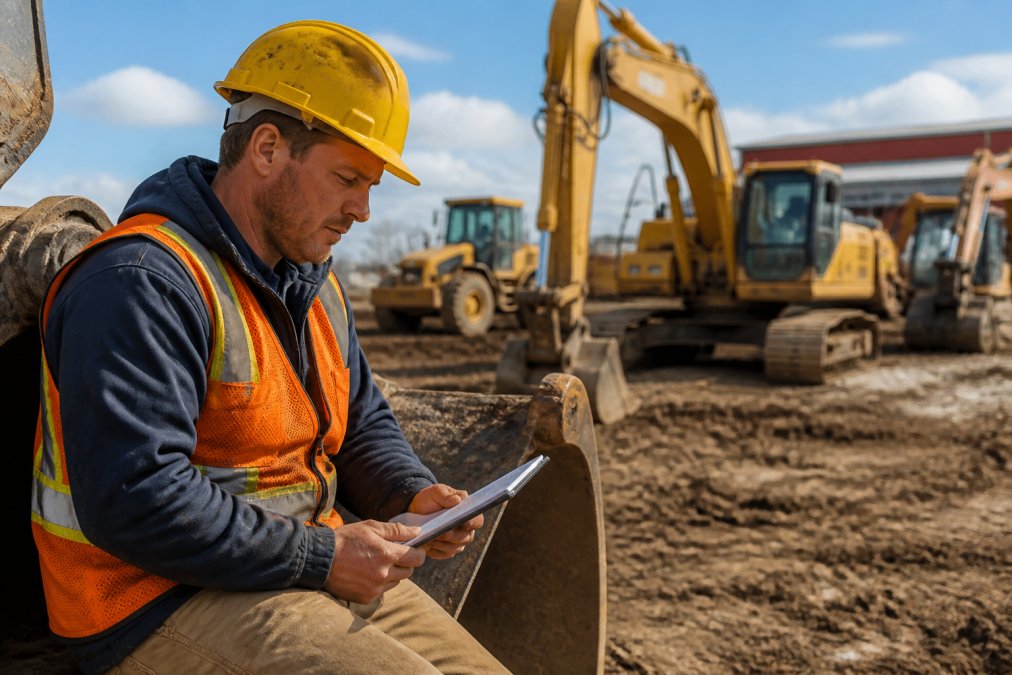
These programs cover safety protocols, equipment inspection procedures, operational theory, hazard recognition, and professional judgment. Unlike generic compliance courses, they're equipment-specific, teaching excavator fundamentals, dozer operation, wheel loader techniques, and skid steer handling.
A well-designed program moves from foundational concepts to specific techniques to scenario-based decision-making. This progression builds confidence and competency faster than ad hoc field training, where learning depends on which jobs supervisors assign and which situations occur during training.
How Structured Programs Reduce On-Site Risk
Operators trained through structured programs make fewer costly mistakes during early field experience. They understand ground conditions, equipment limitations, and hazard patterns. When stepping into the cab for hands-on training, they're refining technique and building speed, not learning basics.
A study comparing simulator-trained and machine-trained logging equipment operators found no significant performance differences, but contractors saved 36-40% by using external simulator-based training instead of field-only instruction.
Structured programs also create documented training records. Employers can verify operators completed specific modules, passed assessments, and demonstrated safety protocol knowledge. This documentation supports compliance audits and insurance requirements.
How to Verify Operator Proficiency Standards and Training Credibility
Not all training programs are equivalent. Knowing how to evaluate training quality before enrolling prevents wasting time and money on programs that won't improve on-site performance.
Start by checking whether the program is equipment-specific. Generic courses that lump excavators, dozers, and wheel loaders together miss critical differences in control systems, stability concerns, and operational techniques. Real programs teach each machine separately.
Next, examine assessment structure. Legitimate programs include knowledge checks, practical evaluations, and scenario-based questions. Assessments should test decision-making, not just memorization. Quality programs ask "What do you do if the ground suddenly gets soft?" not just "What is ground stability?"
Verify instructor credentials. Instructors should have demonstrated field experience operating the equipment they teach. Look for programs requiring instructors to maintain current certifications and stay current with equipment changes.
Check whether the program includes pre-operation inspection training. This is where operators catch problems before they become safety hazards or equipment damage. Finally, ask whether the program integrates with hands-on training. The best structured programs accelerate hands-on learning, not replace it.
OSHA Heavy Equipment Certification Requirements and Compliance
OSHA doesn't certify equipment operators directly. OSHA sets workplace safety standards employers must follow. Compliance requirements vary by job site, employer, and equipment type.
The OSHA 10-hour card is the most common entry-level credential, covering general construction safety and hazard recognition. It's required by most construction employers but isn't equipment-specific and doesn't demonstrate operational competency.
For forklift and powered industrial truck operations, OSHA requires employers to provide equipment-specific training and certification through authorized providers, including classroom instruction and hands-on evaluation. Similar requirements apply to cranes, where the National Commission for the Certification of Crane Operators (NCCCO) provides industry-standard certification.
Compliance requirements also depend on federal funding. Projects funded by federal agencies often require workers to meet apprenticeship standards or hold union credentials beyond basic OSHA compliance.
Minimum compliance is a floor, not a ceiling. Many employers require certifications beyond OSHA minimums, especially in high-safety industries like mining or large-scale construction. Understanding what target employers actually require shapes your training decisions.
Simulation-Based Training Versus Hands-On Field Learning
Simulation training is growing because it delivers measurable advantages, but it can't completely replace hands-on learning. The strongest approach combines both.
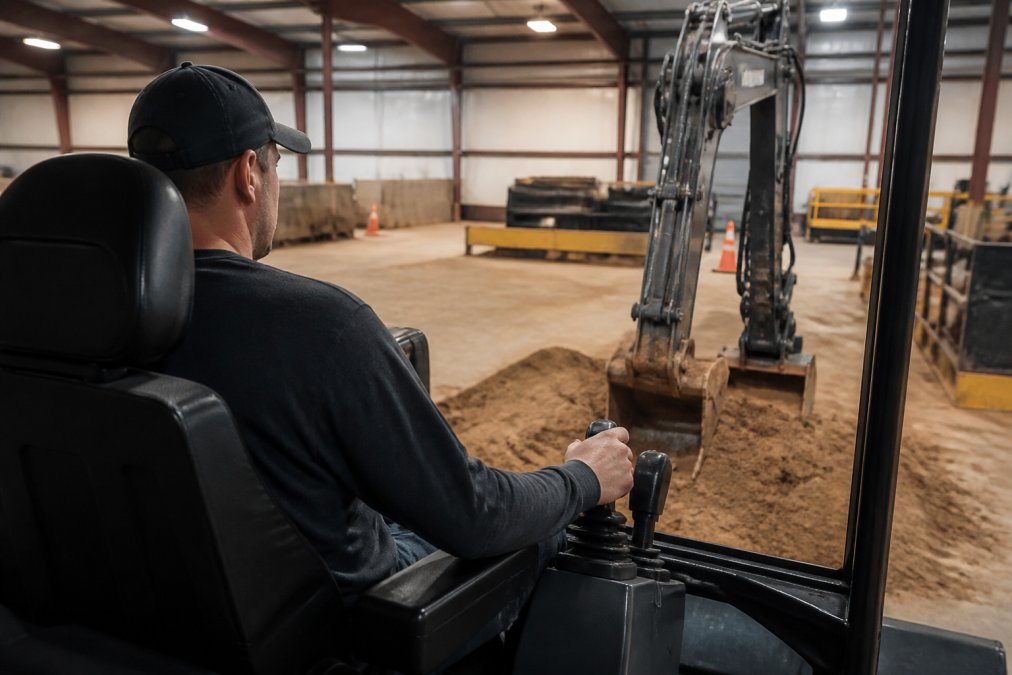
Simulation excels at teaching technique and decision-making without risk or cost. Operators can practice bucket positioning thousands of times, experience tip-over scenarios safely, and learn how ground conditions affect stability without damaging equipment or risking injury. Komatsu's partnership with Immersive Technologies reduced Autonomous Haulage Systems training time by approximately 40% by moving early learning to simulator environments, avoiding critical production equipment downtime.
VR learners feel up to 3.75 times more connected than those in regular classes, and VR training can cut training time by 40-60% while improving results by up to 400%, according to University of Maryland research. This acceleration occurs because simulators eliminate downtime and operators practice continuously.
However, simulation has limits. It can't teach the physical feel of equipment, vibration patterns, weight shifts, or subtle feedback operators use to judge depth and position. Some operators learn better through hands-on experience where mistakes have immediate consequences.
Research is clear: simulation and hands-on training are complementary. A study tracking NCCCO certification candidates found that a simulator test reliably predicts passing scores on actual cranes. Operators trained in simulators first then transitioned to field training showed faster skill development and fewer safety incidents than field-only trained operators.
The optimal pathway: structured knowledge program to build foundational understanding, simulator training to develop technique and decision-making, then hands-on field training to refine skills and build confidence. This sequence reduces total training time and improves safety throughout learning.
Apprenticeship and Pre-Apprenticeship Pathways for Career Advancement
For operators seeking genuine career progression, apprenticeships represent the most comprehensive pathway, combining classroom instruction, hands-on training, and progressive responsibility over multiple years.
Pre-apprenticeships are entry points for people without prior experience. These programs typically run 6 to 12 weeks, focusing on foundational skills, safety awareness, and equipment basics, preparing participants to enter formal apprenticeships or work as supervised equipment operators.
Vinci Construction partnered with Chase Operator Training to develop an innovative training program on live job sites. Over 94% of more than 100 Indigenous students graduated, and over 91% were employed over a 3-year period across 6 different programs. This outcome demonstrates that structured apprenticeship pathways create genuine employment when designed thoughtfully.
Apprenticeships typically last 2 to 4 years and require 2,000 to 4,000 hours of on-the-job training combined with classroom instruction. Participants earn wages while learning, gradually taking on more complex work. Upon completion, apprentices earn industry-recognized credentials and significantly higher earning potential than operators without formal training.
The key advantage is progressive accountability. You're solving real problems on real projects, evaluated by experienced operators with a stake in your success. This real-world pressure accelerates learning in ways classroom instruction alone cannot.
Selecting the Right Training Alternative for Your Situation
The best training path depends on your starting point, timeline, budget, and career goals.
If you're starting with zero equipment experience and need to be productive quickly, begin with a structured knowledge program. This builds foundational understanding efficiently, reducing hands-on training time. The Iron Skills Academy™ Heavy Equipment Operator Training Manual, Student Edition provides this foundation at $30, covering 20 chapters of equipment-specific fundamentals, safety protocols, and inspection procedures.

If you're an instructor building curriculum for multiple students, the Iron Skills Academy™, Instructor Training Package at $99 provides structured materials, assessment resources, and evaluation tools that accelerate program development and ensure consistent quality.

If your organization has access to simulators, prioritize simulation training before field deployment. The cost-benefit analysis is clear: simulators cost less than equipment damage, prevent injuries during learning, and reduce field training time by 40-60%.
If you're seeking career advancement beyond entry-level operation, pursue formal apprenticeship credentials. These are recognized across the industry and open doors to supervisory roles, specialized equipment operation, and higher compensation.
For safety officers and compliance managers, implement a layered approach: structured knowledge programs for foundational understanding, simulator training where available to build proficiency safely, and documented hands-on evaluation to verify field competency. This approach satisfies regulatory requirements while building genuinely skilled operators.
Selecting the right training alternative isn't about finding the cheapest option or quickest certification. It's about building operators who work safely, solve problems independently, and adapt to new equipment and conditions. Iron Skills Academy provides the foundational structured training that accelerates every pathway, whether preparing for hands-on field training, simulator programs, or formal apprenticeships. Start with comprehensive knowledge, then layer in practical experience that builds true proficiency. Get started with Iron Skills Academy and build operators ready for real-world challenges.
=== FAQ ANSWERS (audit these too, same rules) ===
[1] Q: What are the main alternatives to standard hardhat training for heavy equipment operators? A: The primary alternatives include structured knowledge programs (like the Iron Skills Academy Heavy Equipment Operator Training Manual), simulation-based training, apprenticeship pathways, and blended approaches combining online coursework with hands-on field instruction. Structured programs build foundational knowledge before field work, reducing initial on-site risk and training time. Simulation training can reduce early learning by up to 40%, moving foundational skills off live equipment. Apprenticeships provide earning-while-learning models with formal credentialing. Each alternative addresses different operator needs and employer constraints.
[2] Q: How do I verify operator proficiency standards and ensure a training program meets industry requirements? A: Verify credentials by checking whether the provider covers OSHA-compliant safety protocols, equipment-specific fundamentals, and pre-operation inspection procedures. Ask for documentation of curriculum alignment with industry standards and whether completion includes knowledge assessments. Look for programs that address hazard recognition, ground conditions, rigging awareness, and emergency procedures. Accredited programs should clearly state what their certification does and does not cover, genuine training providers distinguish between educational coursework and hands-on competency verification.
[3] Q: What is the typical heavy equipment operator training duration across different alternatives? A: Training duration varies significantly by method. Structured knowledge programs typically require 40-80 hours of self-paced study. Apprenticeships range from 3-4 years with concurrent classroom and on-site work. Simulation-based training can compress foundational learning into 2-3 weeks instead of months in the field. Blended programs combining online modules with supervised hands-on training usually span 6-12 weeks. OSHA 10-hour courses take 1-2 days; 30-hour programs span 1-2 weeks. The key variable is whether training includes practical equipment operation or focuses solely on knowledge and safety protocols.
[4] Q: How do OSHA heavy equipment certification requirements affect my choice of training alternative? A: OSHA does not mandate a single training provider or certification for general heavy equipment operation. However, OSHA requires employers to ensure operators are competent in safety hazards, equipment-specific operation, and regulatory compliance. Your chosen alternative must cover OSHA-required safety protocols including hazard recognition, ground stability, rigging awareness, and emergency procedures. Some industries (crane operation, for example) have stricter third-party certification requirements. Verify that your training alternative explicitly addresses OSHA compliance and documents coverage of required safety topics. Employers remain responsible for verifying operator competency regardless of certification type.
[5] Q: Can operators complete heavy equipment training remotely, or is hands-on classroom time required? A: Knowledge-based training can be completed fully remotely through digital manuals and online modules, which works well for foundational learning before field work. However, actual equipment operation requires supervised hands-on practice on real or simulated machinery. Blended alternatives combine remote coursework (covering safety, inspections, and theory) with required on-site or simulator-based practical sessions. Simulation training allows remote participation in virtual equipment operation. Pure remote-only programs cannot substitute for hands-on competency evaluation, which employers and manufacturers require before operators work independently on live equipment. The most effective alternatives pair remote knowledge building with structured hands-on verification.
Frequently Asked Questions
What are the main alternatives to standard hardhat training for heavy equipment operators?
The primary alternatives include structured knowledge programs (like the Iron Skills Academy Heavy Equipment Operator Training Manual), simulation-based training, apprenticeship pathways, and blended approaches combining online coursework with hands-on field instruction. Structured programs build foundational knowledge before field work, reducing initial on-site risk and training time. Simulation training can reduce early learning by up to 40%, moving foundational skills off live equipment. Apprenticeships provide earning-while-learning models with formal credentialing. Each alternative addresses different operator needs and employer constraints.
How do I verify operator proficiency standards and ensure a training program meets industry requirements?
Verify credentials by checking whether the provider covers OSHA-compliant safety protocols, equipment-specific fundamentals, and pre-operation inspection procedures. Ask for documentation of curriculum alignment with industry standards and whether completion includes knowledge assessments. Look for programs that address hazard recognition, ground conditions, rigging awareness, and emergency procedures. Accredited programs should clearly state what their certification does and does not cover, genuine training providers distinguish between educational coursework and hands-on competency verification.
What is the typical heavy equipment operator training duration across different alternatives?
Training duration varies significantly by method. Structured knowledge programs typically require 40-80 hours of self-paced study. Apprenticeships range from 3-4 years with concurrent classroom and on-site work. Simulation-based training can compress foundational learning into 2-3 weeks instead of months in the field. Blended programs combining online modules with supervised hands-on training usually span 6-12 weeks. OSHA 10-hour courses take 1-2 days; 30-hour programs span 1-2 weeks. The key variable is whether training includes practical equipment operation or focuses solely on knowledge and safety protocols.
How do OSHA heavy equipment certification requirements affect my choice of training alternative?
OSHA does not mandate a single training provider or certification for general heavy equipment operation. However, OSHA requires employers to ensure operators are competent in safety hazards, equipment-specific operation, and regulatory compliance. Your chosen alternative must cover OSHA-required safety protocols including hazard recognition, ground stability, rigging awareness, and emergency procedures. Some industries (crane operation, for example) have stricter third-party certification requirements. Verify that your training alternative explicitly addresses OSHA compliance and documents coverage of required safety topics. Employers remain responsible for verifying operator competency regardless of certification type.
Can operators complete heavy equipment training remotely, or is hands-on classroom time required?
Knowledge-based training can be completed fully remotely through digital manuals and online modules, which works well for foundational learning before field work. However, actual equipment operation requires supervised hands-on practice on real or simulated machinery. Blended alternatives combine remote coursework (covering safety, inspections, and theory) with required on-site or simulator-based practical sessions. Simulation training allows remote participation in virtual equipment operation. Pure remote-only programs cannot substitute for hands-on competency evaluation, which employers and manufacturers require before operators work independently on live equipment. The most effective alternatives pair remote knowledge building with structured hands-on verification.
This article was written using GrandRanker