

Table of Contents
- Why Remote Heavy Equipment Operator Safety Courses Matter
- Heavy Equipment Operator Training Duration and Program Structure
- OSHA Heavy Equipment Certification Online: What You Need to Know
- Best Practices for Remote Equipment Operation
- Core Safety Competencies in Remote Training Programs
- Hands-On Validation vs. Simulation in Remote Safety Training
- Conclusion
Last Updated: August 29, 2026
Why Remote Heavy Equipment Operator Safety Courses Matter
The construction industry recorded 2.3 nonfatal occupational injuries and illnesses per 100 full-time workers in 2023, according to ISHN data from the United States Bureau of Labor Statistics. Remote heavy equipment operator safety courses represent a fundamental shift in how operators learn critical skills without compromising safety standards or operational readiness.
The global heavy equipment training simulator market was valued at $1.8 billion in 2025 and is projected to reach $4.1 billion by 2034, expanding at a compound annual growth rate of 9.5%, according to Dataintelo's Heavy Equipment Training Simulator Market Research Report. This growth reflects industry consensus: structured, technology-enabled training reduces incidents, cuts training costs, and produces operators who perform at or above the level of those trained through traditional on-site methods.
The real advantage of remote heavy equipment operator safety training is effectiveness. When operators learn inspection protocols, hazard recognition, and equipment fundamentals before stepping into the cab, they make fewer costly mistakes. They understand why pre-operation inspections matter before they skip one on a real job site. They've practiced responding to equipment failures in a simulator where the consequences are zero.
Below, we'll show you exactly how remote training programs work, what certifications actually matter, and how to validate that simulation-based learning translates to real-world competency. Whether you're an individual seeking foundational knowledge, an instructor building curriculum, or a safety officer ensuring workforce compliance, this guide covers the essential elements that separate effective remote training from programs that simply check a box.

Heavy Equipment Operator Training Duration and Program Structure
A comprehensive remote heavy equipment operator safety training program typically spans 40-80 hours of instruction, depending on equipment type and depth of certification. This timeline breaks down into three distinct phases: foundational safety knowledge (10-15 hours), equipment-specific operation and inspection (20-40 hours), and competency validation through simulation and assessment (10-25 hours).
According to research from the Association of Equipment Manufacturers on operator development standards, operators who receive modular, focused instruction on specific equipment outperform those who sit through generic heavy machinery overviews. Iron Skills Academy's curriculum targets specific equipment (excavators, dozers, wheel loaders, skid steers, backhoes, motor graders) with dedicated content on inspection protocols, operational fundamentals, and safety-critical procedures.

Most programs compress this into 2-6 weeks of part-time study, allowing operators to continue working while building competency. Full-time intensive programs can complete the core curriculum in 1-2 weeks.
A critical distinction: training duration ≠ certification timeline. Completing a remote course is step one. Most employers require hands-on validation with a certified instructor on actual equipment before an operator is authorized for independent operation. This dual-path approach combines the efficiency gains of simulation with the safety assurance of direct observation.
| Training Phase | Duration | Content Focus | Delivery Method |
|---|---|---|---|
| Foundational Safety | 10-15 hours | OSHA standards, hazard recognition, incident prevention | E-learning modules, video instruction |
| Equipment-Specific Operation | 20-40 hours | Pre-operation inspection, operating fundamentals, maintenance awareness | Simulator training, interactive guides, equipment walkarounds |
| Competency Validation | 10-25 hours | Practical assessment, scenario-based testing, real equipment sign-off | Simulation assessment, on-site evaluation |
OSHA Heavy Equipment Certification Online: What You Need to Know
OSHA does not issue operator certifications directly. Instead, OSHA sets safety standards and regulations; third-party organizations (NCCCO, NCCER, state vocational boards) issue certifications that demonstrate compliance with those standards.
Online OSHA training effectively teaches classroom-style knowledge, including hazard recognition, inspection procedures, load charts, safe operating practices, and relevant OSHA standards. However, OSHA explicitly states that online training is not a substitute for hands-on evaluation, site-specific instruction, or authorization from an employer.
A remote heavy equipment operator safety course can prepare you to pass a written certification exam and understand regulatory requirements. It cannot, on its own, authorize you to operate equipment on a job site. That authorization requires documented on-site training and sign-off from a qualified supervisor or certified trainer.
For construction teams, a hybrid approach is mandatory. Remote training handles the theoretical foundation, OSHA compliance, equipment mechanics, hazard mitigation, and work zone safety protocols. On-site supervision handles the practical validation. Iron Skills Academy's curriculum aligns with this reality by providing the structured knowledge component that accelerates on-site training timelines.
Certification renewal typically requires some form of assessment, either written, simulator-based, or on-site observation, every 3-5 years.
Best Practices for Remote Equipment Operation
Remote heavy equipment operation, where an operator controls machinery from an office workstation rather than the cab, introduces distinct safety and operational challenges. The sensory feedback is different. The lag between input and machine response requires adjustment. Situational awareness comes entirely through camera feeds and telemetry, not direct sight lines.
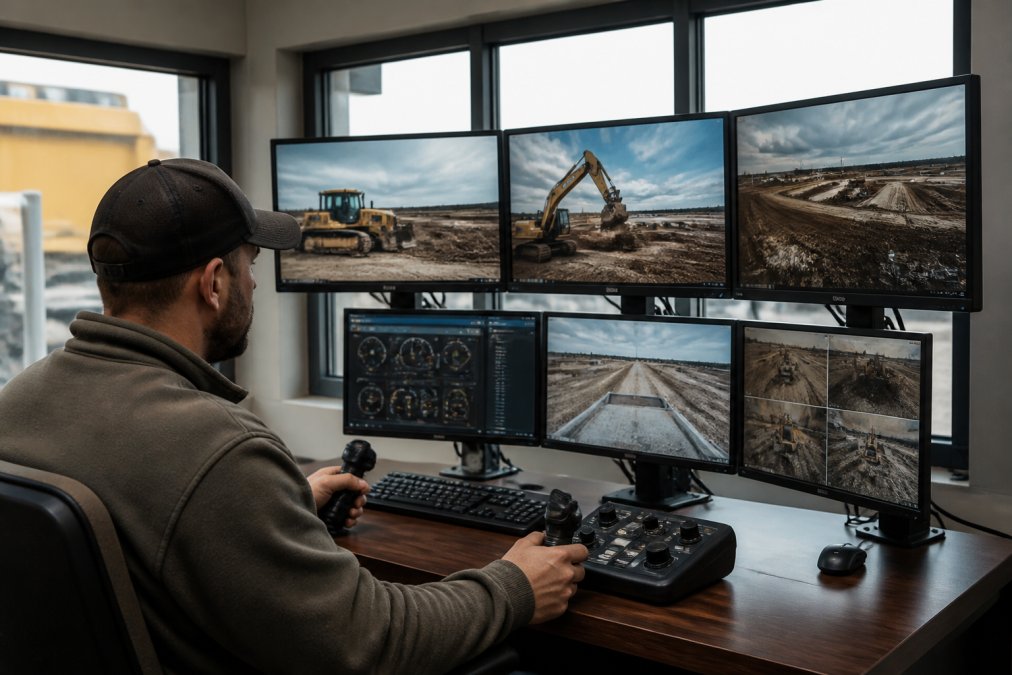
Training design must acknowledge this reality. Caterpillar's remote operation training solution for semi-autonomous underground Load Haul Dumps explicitly teaches operators how to interpret equipment telemetry and camera feeds as a substitute for being in the cab.
Practical remote operation best practices include:
-
Monitor multiple data streams simultaneously. Remote operators must scan equipment telemetry (hydraulic pressure, boom angle, bucket load), camera feeds (site conditions, obstacles, personnel), and status indicators continuously. Training should include drills that build this scanning habit until it becomes automatic.
-
Establish clear communication protocols with site personnel. Remote operators depend on spotters, site supervisors, and equipment-mounted cameras. Training must cover radio communication standards, hand signal interpretation via camera, and escalation procedures when visibility is compromised.
-
Manage fatigue and mental load actively. Remote operation is cognitively demanding. Best practice includes scheduled breaks, shift rotations (no more than 4-6 continuous hours), and fatigue monitoring protocols.
-
Validate equipment telemetry accuracy before operation. Pre-shift telemetry checks must be as rigorous as traditional pre-operation inspections.
Core Safety Competencies in Remote Training Programs
Effective remote heavy equipment operator safety training builds competency across five interconnected domains: regulatory knowledge, equipment fundamentals, hazard mitigation, inspection protocols, and emergency response.
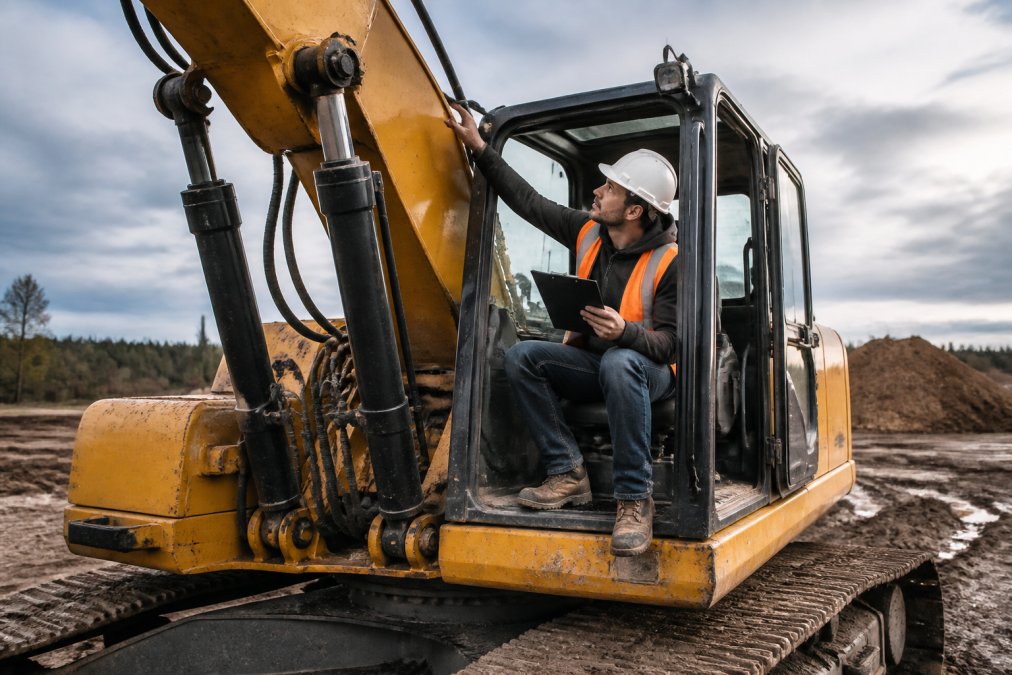
Regulatory Knowledge covers OSHA standards, state-specific requirements, and industry-standard safety practices. Operators must understand not just what the rules are, but why they exist.
Equipment Fundamentals includes the mechanical and hydraulic systems that make equipment operate. This is practical understanding of what happens when hydraulic pressure spikes, why boom angle matters for load capacity, and how wear patterns signal maintenance needs.
Hazard Mitigation teaches operators to recognize and respond to common site hazards: underground utilities, unstable ground, nearby personnel, weather conditions, and equipment limitations. Remote operators must learn to identify hazards through camera feeds and telemetry rather than direct observation.
Pre-Operation Equipment Inspection Protocols
A pre-operation inspection is the single most effective safety intervention an operator can perform. It catches equipment problems before they become incidents.
Effective remote training makes inspection protocols automatic by embedding them into muscle memory before operators touch real equipment. The curriculum should cover:
- Visual walk-around inspection - checking for obvious damage, fluid leaks, worn components, and debris
- Hydraulic system checks - verifying fluid levels, hose integrity, and pressure readings
- Structural integrity assessment - looking for cracks, bent components, and loose fasteners
- Control system testing - confirming all controls respond correctly and smoothly
- Safety device verification - testing alarms, warning lights, and emergency stops
Iron Skills Academy's training materials include equipment-specific inspection guides for excavators, dozers, wheel loaders, skid steers, backhoes, and motor graders, each with detailed photo references and common failure points.
Hazard Mitigation and Work Zone Safety
Work zone safety extends beyond the operator's immediate control. Site conditions, nearby personnel, underground utilities, and weather all create hazards that operators must recognize and respond to appropriately.
Research from AFIT Scholar found that operators trained using immersive virtual reality simulators for wheel loader operations showed a 40% reduction in collisions compared to traditionally trained operators. This improvement reflects better hazard awareness and faster response times.
Effective hazard mitigation training includes identifying underground utilities, recognizing unstable ground conditions, managing personnel in work zones, adapting to weather changes, and understanding load limits. Remote training scenarios should include situations where operators must stop work due to hazard conditions, developing decision-making competency that separates trained operators from those who simply know procedures.
Hands-On Validation vs. Simulation in Remote Safety Training
Simulation-based remote training is exceptionally effective for building knowledge, practicing procedures, and developing decision-making skills. It's less effective at developing the tactile feel operators need for precision work or the instinctive responses that come from operating equipment under real-world constraints.
Research from ASCE Library demonstrates that naive subjects trained using a comprehensive hydraulic excavator simulator improved their performance to match expert operators on simple tasks after just 7 training days. However, operators trained with novel interface designs achieved 37% faster cycle times than those using traditional joystick controls, suggesting that interface design matters as much as simulation itself.
The industry standard has shifted toward a hybrid model: remote training builds the foundation, hands-on validation confirms competency. Conewago Enterprises implemented simulation-based training for crane operators and reduced onsite training time from 6 months to 7 weeks, a 70% reduction, while cutting training costs from $40,000 to $15,000 per trainee. The simulation didn't replace hands-on training; it made hands-on training vastly more efficient because operators arrived already knowing the fundamentals.
For remote-operated equipment specifically, validation focuses on telemetry interpretation, camera feed analysis, and decision-making under the constraints of remote operation. Caterpillar's approach, training 19 new female Minegem operators who delivered more than 1,000 tons per shift with an average of just 29 days training, demonstrates that remote operation competency can be validated efficiently when training is designed specifically for remote operation.
The critical question for any organization: What does competency actually mean for your operation? If operators will work in cabs, hands-on validation is non-negotiable. If operators will work remotely, validation should test remote-specific skills. If operators will transition between remote and cab operation, training and validation must cover both modalities.
Iron Skills Academy's training materials support both pathways. The curriculum provides the foundational knowledge, inspection protocols, hazard recognition, equipment mechanics, and safety compliance that accelerates any subsequent hands-on training. For organizations using remote operation, the materials include remote-specific content on telemetry interpretation and camera-feed hazard recognition.
Remote heavy equipment operator safety courses have moved beyond "nice to have" to essential infrastructure for any organization managing equipment operations at scale. The market growth, from $1.8 billion in 2025 to a projected $4.1 billion by 2034, reflects this shift. Organizations that invest in structured remote training see measurable improvements: faster operator certification, fewer on-site incidents, lower training costs, and better retention of experienced operators.
The challenge isn't whether to implement remote training. It's ensuring the training you choose actually builds the competencies your operators need. Start with Iron Skills Academy's comprehensive training resources, which cover the full spectrum of heavy equipment types and include both foundational knowledge and equipment-specific protocols. Our curriculum accelerates hands-on training timelines and provides the structured foundation that separates competent operators from those who've simply logged hours. Start Training with Iron Skills Academy and build a workforce that operates safely, efficiently, and with genuine equipment competency.
=== FAQ ANSWERS (audit these too, same rules) ===
[1] Q: Can I get heavy equipment operator certification online? A: Yes, online courses can teach classroom-style knowledge including hazard recognition, inspection procedures, load charts, and OSHA standards. However, certification requires hands-on evaluation and site-specific instruction. Remote heavy equipment operator safety courses provide the theoretical foundation, but you must complete practical assessments with real equipment to achieve full certification. Many operators combine online modules with supervised field training to meet regulatory requirements.
[2] Q: What is included in a typical heavy equipment operator training duration? A: Training duration varies by equipment type and depth. Basic operator competency typically requires 4-8 weeks of combined classroom and hands-on instruction. Comprehensive programs covering multiple equipment types (excavators, dozers, wheel loaders, backhoes) may extend 8-12 weeks. Remote modules compress classroom time significantly. Total certification timelines depend on whether you pursue OSHA-30, manufacturer-specific credentials, or NCCER certification.
[3] Q: Are online heavy equipment safety courses recognized by employers? A: Yes, when properly structured. OSHA recognizes online training for hazard awareness and safety protocols, provided it meets regulatory standards. Employers value remote courses when they cover pre-operation inspections, work zone safety, hazard mitigation, and equipment-specific competencies. However, employers require proof of hands-on operator proficiency, online training alone does not authorize equipment operation without supervised field validation.
[4] Q: What safety topics should remote equipment operator training cover? A: Essential topics include pre-operation inspection checklists, OSHA compliance standards, work zone safety and hazard awareness, equipment maintenance fundamentals, load chart interpretation, and emergency response procedures. For remote-specific operation, training must address operator ergonomics, fatigue management during extended remote shifts, telemetry data interpretation, and situational awareness limitations inherent to tele-operation. Comprehensive programs also include confined space entry awareness, trenching safety protocols, and rigging and signaling basics depending on equipment type and jobsite conditions.
Frequently Asked Questions
Can I get heavy equipment operator certification online?
Yes, online courses can teach classroom-style knowledge including hazard recognition, inspection procedures, load charts, and OSHA standards. However, certification requires hands-on evaluation and site-specific instruction. Remote heavy equipment operator safety courses provide the theoretical foundation, but you must complete practical assessments with real equipment to achieve full certification. Many operators combine online modules with supervised field training to meet regulatory requirements.
What is included in a typical heavy equipment operator training duration?
Training duration varies by equipment type and depth. Basic operator competency typically requires 4-8 weeks of combined classroom and hands-on instruction. Comprehensive programs covering multiple equipment types (excavators, dozers, wheel loaders, backhoes) may extend 8-12 weeks. Remote modules compress classroom time significantly. Total certification timelines depend on whether you pursue OSHA-30, manufacturer-specific credentials, or NCCER certification.
Are online heavy equipment safety courses recognized by employers?
Yes, when properly structured. OSHA recognizes online training for hazard awareness and safety protocols, provided it meets regulatory standards. Employers value remote courses when they cover pre-operation inspections, work zone safety, hazard mitigation, and equipment-specific competencies. However, employers require proof of hands-on operator proficiency, online training alone does not authorize equipment operation without supervised field validation.
What safety topics should remote equipment operator training cover?
Essential topics include pre-operation inspection checklists, OSHA compliance standards, work zone safety and hazard awareness, equipment maintenance fundamentals, load chart interpretation, and emergency response procedures. For remote-specific operation, training must address operator ergonomics, fatigue management during extended remote shifts, telemetry data interpretation, and situational awareness limitations inherent to tele-operation. Comprehensive programs also include confined space entry awareness, trenching safety protocols, and rigging and signaling basics depending on equipment type and jobsite conditions.
This article was written using GrandRanker