

Table of Contents
- Defining Formal Training and On-the-Job Training
- Key Differences: Structured Learning vs Learning by Doing
- Theoretical Knowledge vs Practical Application in Heavy Equipment Operation
- Cost Implications and Training ROI
- Training Duration for Heavy Equipment Operators
- On-the-Job Training Best Practices for Heavy Machinery
- Heavy Equipment Operator Certification Requirements and Training Paths
- Hybrid Training Models: Combining Formal and On-the-Job Approaches
Last Updated: August 23, 2026
According to Lorman's 2026 Training Statistics, 70% of employee skills are learned on the job, yet many organizations remain uncertain whether to invest in structured formal programs or rely on practical mentorship. For heavy equipment operators especially, the answer isn't either/or, it's understanding where each approach excels and where they fall short.

Research from PeopleGoal's 2026 Employee Training Stats indicates that 68% of employees prefer to learn while working, yet companies with strong formal training programs see 218% higher income per employee. The gap between preference and performance suggests that what learners like and what actually works can be different things. Below, we'll show you exactly how formal training and on-the-job training differ, where each wins, and most importantly, how to combine them for operators who are both safer and faster on the jobsite.
Defining Formal Training and On-the-Job Training
What Is Formal Training?
Formal training is structured, instructor-led instruction delivered in a controlled environment with defined learning outcomes, assessments, and completion criteria. It prioritizes theory first: trainees learn why procedures exist, what can go wrong, how to recognize hazards, and the mechanical principles behind equipment operation.
For heavy equipment operation, formal training covers pre-operation inspection procedures, safety protocols, ground condition assessment, and emergency response. Iron Skills Academy's Heavy Equipment Operator Training Manual exemplifies this approach with 20 structured chapters covering excavator, dozer, wheel loader, skid steer, and backhoe fundamentals, plus 200 practice questions and a 50-question final assessment. The structure means accountability, learners pass assessments that verify understanding before getting near a live machine, and organizations can document compliance for regulatory and insurance purposes.
What Is On-the-Job Training?
On-the-job training (OJT) is practical instruction delivered in the actual work environment, where a trainee learns by doing under the guidance of an experienced operator. Learning happens during real production work, with immediate feedback and real-world problem-solving.
OJT's advantage is speed and relevance. Trainees learn the specific workflows, equipment variations, and site conditions they'll actually encounter. They see consequences immediately. The risk is inconsistency: if the experienced operator is a poor teacher or rushed, the trainee absorbs bad habits or learns to operate the machine without understanding why they're doing something or what to do when conditions change.
Key Differences: Structured Learning vs Learning by Doing
| Aspect | Formal Training | On-the-Job Training |
|---|---|---|
| Environment | Classroom, lab, or simulator | Live jobsite during production |
| Sequence | Theory first, then application | Application first, theory as needed |
| Pace | Instructor-led, standardized | Trainee's learning speed, real-world pace |
| Feedback | Delayed (quizzes, assessments) | Immediate (machine response, supervisor correction) |
| Consistency | High (same material for all) | Variable (depends on supervising operator) |
| Knowledge Gaps | Identified before live work | Discovered during live work |
Formal training builds a foundation by answering "why" before "how." On-the-job training builds speed and judgment. Research from MIT Sloan's 2022 survey of U.S. workers found that workers trained solely through OJT often lack fundamental understanding of why procedures are performed.
Theoretical Knowledge vs Practical Application in Heavy Equipment Operation
Heavy equipment operation demands both. Theoretical knowledge covers the mechanical principles: how hydraulic systems work, why ground conditions affect stability, what load ratings mean. It explains the why behind procedures. Practical application is where theory meets reality, an operator who understands hydraulic pressure can diagnose problems; one who understands load physics can recognize when a lift is getting risky.
According to Coassemble's 2026 training statistics, 86% of employees say they learn new skills primarily on the job, yet 61% report having access to formal workplace training. For heavy equipment specifically, the stakes are high. A mistake in judgment can damage equipment worth hundreds of thousands of dollars or injure the operator and crew. Formal training creates a safety floor; on-the-job training creates the ceiling.
Cost Implications and Training ROI
Heavy equipment operator training programs typically cost between $4,000-$15,000 per person for formal instruction, according to Climb Credit's 2021 heavy equipment training cost analysis. When a top-performing operator is pulled off production to train someone, the organization loses their productivity. If training is done poorly, the trainee requires retraining or produces substandard work.
Companies with strong training programs see 218% higher income per employee. The global corporate training market was valued at USD 163.5 billion in 2023 and is projected to grow to USD 326.84 billion by 2032, reflecting organizational recognition that training ROI is real.
For heavy equipment operations, a hybrid approach typically favors formal training. On-the-job training with an experienced operator costs roughly $50-$100 per day in lost productivity, plus supervisor time. A 4-week OJT program costs $1,000-$2,000 in direct costs but potentially $10,000+ in lost productivity if the supervising operator is fully dedicated. Formal training front-loads cost but reduces total training time and improves consistency.
Training Duration for Heavy Equipment Operators
Formal training alone typically takes 40-120 hours of classroom and simulator work. On-the-job training alone typically requires 4-12 weeks of supervised practice before an operator is considered competent for independent work.
Heavy equipment labor needs are projected to grow 4% from 2023 to 2033, which creates pressure to train operators faster, favoring structured formal training that can be delivered consistently and scaled. By 2026, excavator operators need skills beyond simply operating machinery, including safe operation, high machine performance, knowledge of modern technologies and digital applications, and the ability to achieve higher productivity.
On-the-Job Training Best Practices for Heavy Machinery
When OJT is done well, it's powerful. When it's done poorly, it's dangerous. The difference is structure.
Define learning objectives before training starts. The supervising operator needs to know what the trainee should be able to do by the end of each week. "Complete pre-operation inspection without prompting" and "operate in a straight line with smooth bucket control" are specific and measurable.
Use a structured checklist. Document what the trainee has practiced, what they've demonstrated competency on, and what still needs work. This prevents gaps and creates accountability.
Rotate between observation, guided practice, and independent work. Week 1: trainee watches and asks questions. Week 2: trainee operates while the supervisor watches and corrects. Week 3: trainee operates with the supervisor nearby but not directly guiding. Week 4: trainee operates independently with periodic check-ins.
Separate training from production pressure. If the supervisor is training while also trying to hit production targets, training gets deprioritized. Dedicate time specifically for learning.
Provide feedback immediately. OJT's advantage is real-time correction. When the trainee makes a mistake, the supervisor should explain what went wrong and why, right then.
Document completion and competency. When the trainee completes OJT, document what they've learned and what they can do independently.
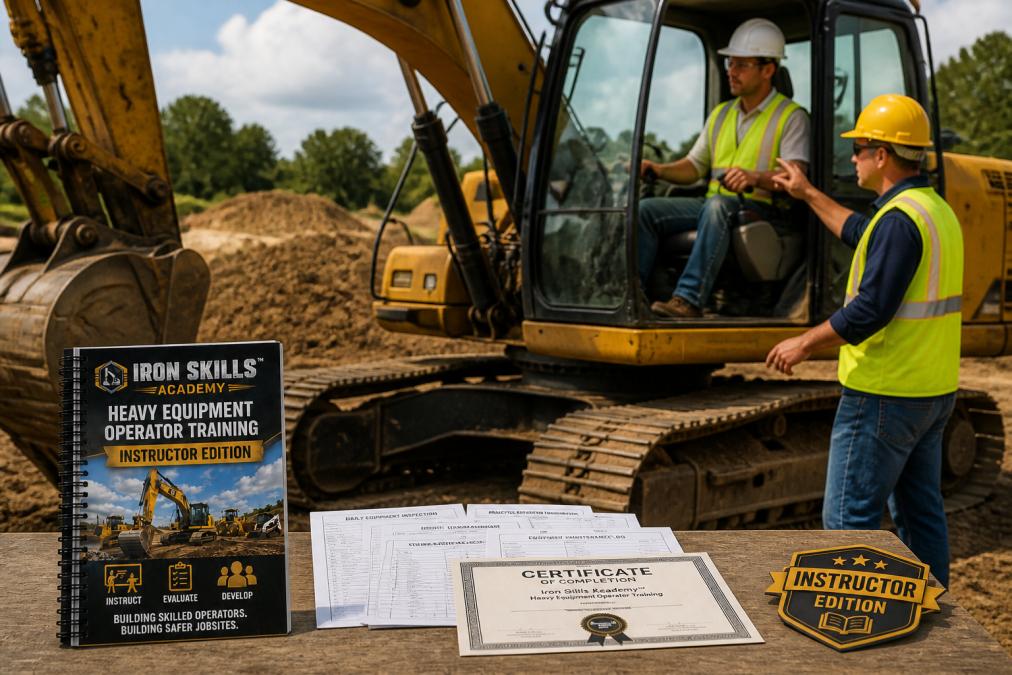
Heavy Equipment Operator Certification Requirements and Training Paths
Certification requirements vary by jurisdiction, employer, and equipment type. OSHA doesn't mandate operator certification for most heavy equipment, but OSHA does require that operators be competent and trained. Many employers require operators to pass a written assessment and demonstrate hands-on competency before operating independently.
The most common path is employer-based competency verification: the operator completes formal training, passes a written assessment, completes on-the-job training under supervision, and is signed off as competent by a supervisor or certified instructor. Some operators pursue NCCER (National Center for Construction Education and Research) certification or similar industry credentials.
The practical path for most operators: formal training (40-80 hours) plus on-the-job training (4-8 weeks) plus employer competency verification. Total time: 2-3 months. Cost: $4,000-$15,000 for formal training plus supervisor time for OJT.
Hybrid Training Models: Combining Formal and On-the-Job Approaches
The evidence increasingly points toward hybrid models as the most effective approach. Formal training builds the foundation; on-the-job training builds the judgment. The sequence matters: formal training first establishes the why and the safety framework, then on-the-job training applies that knowledge in real conditions.
Phase 1: Formal Foundations (40-80 hours) Trainee completes structured training covering safety, pre-operation inspection, equipment fundamentals, and hazard recognition. Iron Skills Academy's Heavy Equipment Operator Training Manual guides this phase with 20 chapters covering all major equipment types.
Phase 2: Supervised On-the-Job Training (4-8 weeks) Trainee works alongside an experienced operator, applying what they learned in formal training to real jobsite conditions. The supervisor corrects mistakes, explains why procedures matter in practice, and gradually increases the trainee's autonomy.
Phase 3: Competency Verification Trainee demonstrates independent competency through practical evaluation and supervisor sign-off.
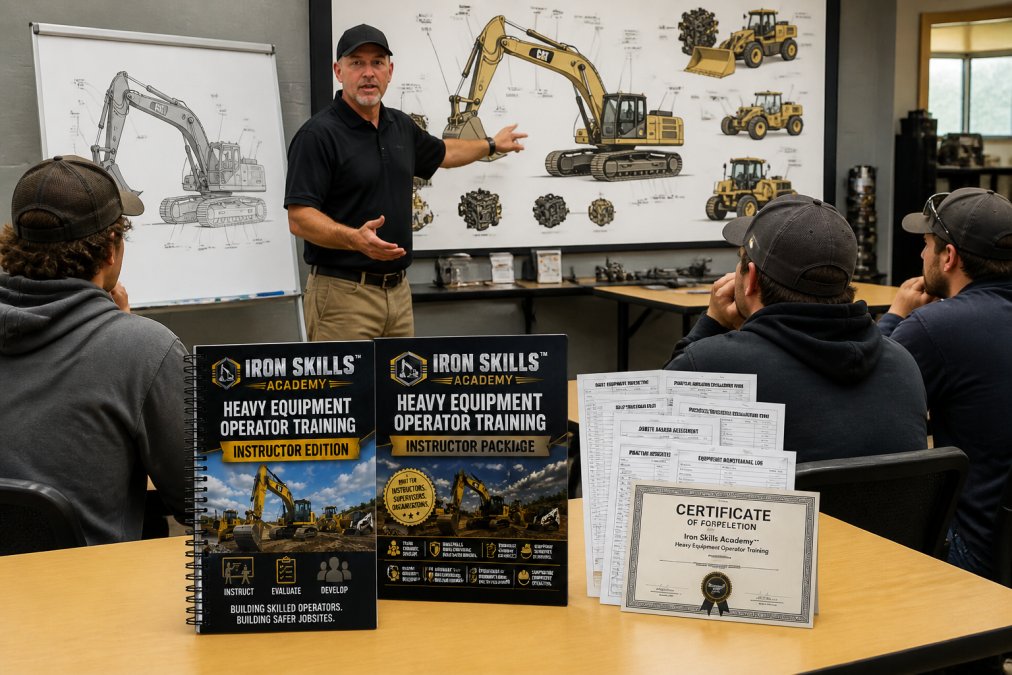
The hybrid model addresses the weaknesses of each approach alone. Formal training without OJT produces operators who know the theory but lack jobsite judgment. On-the-job training without formal grounding produces operators who can do specific tasks but don't understand why or how to adapt when conditions change.
Organizations using hybrid models report faster operator development, fewer mistakes, better safety outcomes, and higher retention. The upfront investment in formal training pays dividends through reduced supervision needs and fewer costly errors.
The choice between formal training and on-the-job training isn't really a choice. Both matter. The question is how to sequence them and how to structure each phase so operators emerge safer, faster, and more capable of handling the complexity of modern heavy equipment operation.
For organizations building a training program, start with structured formal training that establishes the foundation. Follow with supervised on-the-job training that builds judgment and speed. Verify competency before releasing operators to independent work.
Get started with Iron Skills Academy's Heavy Equipment Operator Training Manual, Student Edition (starting at ALL 30) or the Instructor Training Package (ALL 99) to establish the formal foundation your training program needs.
=== FAQ ANSWERS (audit these too, same rules) ===
[1] Q: What is the main difference between formal training and on-the-job training? A: Formal training occurs in structured classroom or training center environments with instructors teaching theory, safety, and standardized procedures. On-the-job training happens in real work settings where experienced operators mentor trainees while performing actual tasks. Research shows 70% of employee skills are learned on the job, while formal training provides comprehensive theoretical knowledge and competency-based certification. For heavy equipment operators, formal training typically covers pre-operation inspections and safety protocols, while OJT develops practical machine handling skills through supervised hands-on experience.
[2] Q: Can you combine formal and on-the-job training for better results? A: Yes, hybrid training models deliver superior outcomes. A combination of structured classroom instruction and hands-on mentorship reinforces learning and ensures operators understand both the 'why' and 'how' of equipment operation. Formal training builds foundational knowledge about safety and machine systems, while OJT allows immediate application in real-world scenarios. Studies show micro-training delivers 22% higher information retention than traditional training alone. For heavy equipment operators, this approach ensures competency in both theoretical knowledge and practical application before independent operation.
[3] Q: How long does it take to train a heavy equipment operator? A: Training duration varies by method and equipment type. Formal training programs typically range from 4-12 weeks for foundational certification, while on-the-job training can take 3-6 months to develop full operational competency. Specialized programs cost between $4,000-$15,000 and vary in length. Most operators benefit from combining both approaches: initial formal instruction (2-4 weeks) followed by supervised on-the-job training (4-8 weeks) to reach safe, independent operation. Heavy equipment labor demand is growing 4% annually through 2033, making structured training timelines essential for meeting industry standards.
[4] Q: What are the best practices for on-the-job training in heavy equipment operations? A: Effective OJT requires clear learning objectives, experienced mentors, structured progression, and documented competency checks. Assign a dedicated trainer to work with each trainee, establish daily skill milestones, and use real equipment inspections and jobsite scenarios to build practical knowledge. Document training completion and performance metrics to ensure consistency across your workforce. Organizations implementing structured OJT with defined skill outcomes see fewer safety incidents and faster operator development than informal hand-offs. Include pre-operation inspections, ground condition assessment, and hazard recognition as core OJT components.
[5] Q: Do heavy equipment operators need formal certification, or is on-the-job training enough? A: Most construction and mining companies require operators to complete both formal training and OJT to meet safety and regulatory standards. Formal training provides documented competency in safety protocols, pre-operation inspections, and equipment fundamentals. On-the-job training proves practical proficiency on specific machines and jobsite conditions. Many employers use formal certification as the foundation, then validate operational readiness through supervised hands-on training. Iron Skills Academy's Instructor Training Package provides structured materials that combine both approaches, helping organizations meet compliance requirements while developing genuinely competent operators ready for independent fieldwork.
Frequently Asked Questions
What is the main difference between formal training and on-the-job training?
Formal training occurs in structured classroom or training center environments with instructors teaching theory, safety, and standardized procedures. On-the-job training happens in real work settings where experienced operators mentor trainees while performing actual tasks. Research shows 70% of employee skills are learned on the job, while formal training provides comprehensive theoretical knowledge and competency-based certification. For heavy equipment operators, formal training typically covers pre-operation inspections and safety protocols, while OJT develops practical machine handling skills through supervised hands-on experience.
Can you combine formal and on-the-job training for better results?
Yes, hybrid training models deliver superior outcomes. A combination of structured classroom instruction and hands-on mentorship reinforces learning and ensures operators understand both the 'why' and 'how' of equipment operation. Formal training builds foundational knowledge about safety and machine systems, while OJT allows immediate application in real-world scenarios. Studies show micro-training delivers 22% higher information retention than traditional training alone. For heavy equipment operators, this approach ensures competency in both theoretical knowledge and practical application before independent operation.
How long does it take to train a heavy equipment operator?
Training duration varies by method and equipment type. Formal training programs typically range from 4-12 weeks for foundational certification, while on-the-job training can take 3-6 months to develop full operational competency. Specialized programs cost between $4,000-$15,000 and vary in length. Most operators benefit from combining both approaches: initial formal instruction (2-4 weeks) followed by supervised on-the-job training (4-8 weeks) to reach safe, independent operation. Heavy equipment labor demand is growing 4% annually through 2033, making structured training timelines essential for meeting industry standards.
What are the best practices for on-the-job training in heavy equipment operations?
Effective OJT requires clear learning objectives, experienced mentors, structured progression, and documented competency checks. Assign a dedicated trainer to work with each trainee, establish daily skill milestones, and use real equipment inspections and jobsite scenarios to build practical knowledge. Document training completion and performance metrics to ensure consistency across your workforce. Organizations implementing structured OJT with defined skill outcomes see fewer safety incidents and faster operator development than informal hand-offs. Include pre-operation inspections, ground condition assessment, and hazard recognition as core OJT components.
Do heavy equipment operators need formal certification, or is on-the-job training enough?
Most construction and mining companies require operators to complete both formal training and OJT to meet safety and regulatory standards. Formal training provides documented competency in safety protocols, pre-operation inspections, and equipment fundamentals. On-the-job training proves practical proficiency on specific machines and jobsite conditions. Many employers use formal certification as the foundation, then validate operational readiness through supervised hands-on training. Iron Skills Academy's Instructor Training Package provides structured materials that combine both approaches, helping organizations meet compliance requirements while developing genuinely competent operators ready for independent fieldwork.
This article was written using GrandRanker