

Table of Contents
- Online vs In-Person Dozer Training Programs: Key Differences
- Heavy Equipment Operator Certification Requirements
- Dozer Operator Training Course Duration and Scheduling
- Hands-On Lab and Practical Machine Time: Why It Matters
- Best Practices for Heavy Equipment Operator Training
- Cost Comparison and ROI for Training Programs
- Which Training Format Should You Choose?
- Conclusion
Last Updated: August 20, 2026
Online vs In-Person Dozer Training Programs: Key Differences
The heavy equipment operator industry faces a critical shortage. The U.S. Bureau of Labor projects more than 50,800 new heavy equipment operator positions annually until 2031, yet training programs struggle to produce operators fast enough. The choice between online and in-person dozer training programs is a competitive advantage.

Online components accelerate foundational learning, but hands-on machine time remains non-negotiable for safety and employability. High-performing programs combine online theory with mandatory practical lab work. A construction company cut training time by 50% and improved instructor efficiency by 500% by replacing initial hands-on sessions with simulator-based training, demonstrating the efficiency gains possible when online learning removes repetitive classroom instruction.
Comparison Table: Online vs In-Person at a Glance
| Factor | Online Training | In-Person Training | Hybrid (Online + Lab) |
|---|---|---|---|
| Flexibility | High, study at own pace | Fixed schedule | Moderate, online flexible, labs scheduled |
| Hands-on Machine Time | None (theory only) | Extensive field experience | Mandatory lab component |
| Total Time to Completion | 4-8 weeks (theory) | 8-12 weeks (full program) | 6-10 weeks (blended) |
| Cost per Operator | $500-$1,200 | $2,000-$4,000 | $1,500-$2,500 |
| Employability Readiness | Limited without lab work | High with certification | Highest with structured approach |
| Best For | Foundational knowledge, busy schedules | Career-focused learners | Most operators seeking jobs |
| Safety Protocol Coverage | Interactive modules, assessments | Hands-on site preparation | Both integrated |
Heavy Equipment Operator Certification Requirements
Becoming a certified heavy equipment operator requires meeting specific industry and regulatory standards. Most reputable programs follow NCCER (National Center for Construction Education and Research) guidelines covering equipment anatomy, machine controls, site safety protocols, hazard awareness, and operational techniques. According to U.S. Bureau of Labor Statistics occupational data, heavy equipment operators must demonstrate competency in equipment maintenance, site preparation, and grading operations before employers consider them job-ready.

What separates certified operators from untrained personnel is verified hands-on competency. A practical assessment where the candidate physically operates equipment under supervision is mandatory for legitimate certification. Online-only programs cannot issue full operator certification; they provide foundational knowledge and prepare candidates for the practical exam, but final certification always requires demonstrated machine operation.
Most states require operators to hold equipment-specific certification. Entry-level dozer operators in Ontario earn $20-$30/hour, while experienced operators earn $30-$45+/hour, reflecting the value employers place on verified technical skills and safety compliance.
Dozer Operator Training Course Duration and Scheduling
Online-only dozer training typically takes 4-8 weeks of self-paced study, covering classroom content, equipment controls, safety protocols, and maintenance procedures through interactive modules and assessments. The advantage is flexibility around existing job schedules.
However, online-only completion doesn't equal job readiness. Full in-person programs with significant hands-on machine time typically require 8-12 weeks from start to certification, reflecting the reality that operating a dozer requires muscle memory, spatial awareness, and real-world problem-solving that cannot be simulated on screen.
Hybrid programs combine 4-6 weeks of online foundational learning with 2-4 weeks of structured hands-on lab work, totaling 6-10 weeks. Students arrive at the lab already familiar with controls and safety concepts, allowing instructors to focus lab time on actual operation rather than explaining basics.
Reputable programs schedule labs on weekends or intensive week-long blocks to accommodate working students. Lab sessions require fixed attendance; equipment operation cannot be practiced remotely.
Hands-On Lab and Practical Machine Time: Why It Matters
No amount of online learning replaces sitting in a dozer cab, feeling equipment respond to your inputs, and understanding spatial relationships that only real machine operation teaches.
Hands-on lab time is non-negotiable for operator safety and job performance. Salma Limon, a former food factory worker who transitioned to heavy equipment operation, described the critical role of practical training: "Learning how to position the blade on the simulator helped me know how to control the real dozer blade, which is very similar to the simulator. At first, when I got in the dozer, I had sweaty hands and was shaking a bit. I was afraid of the tilting, but the simulator helped with that too." Her experience illustrates that even with simulator preparation, the transition to real equipment requires hands-on confidence-building that only direct operation provides.
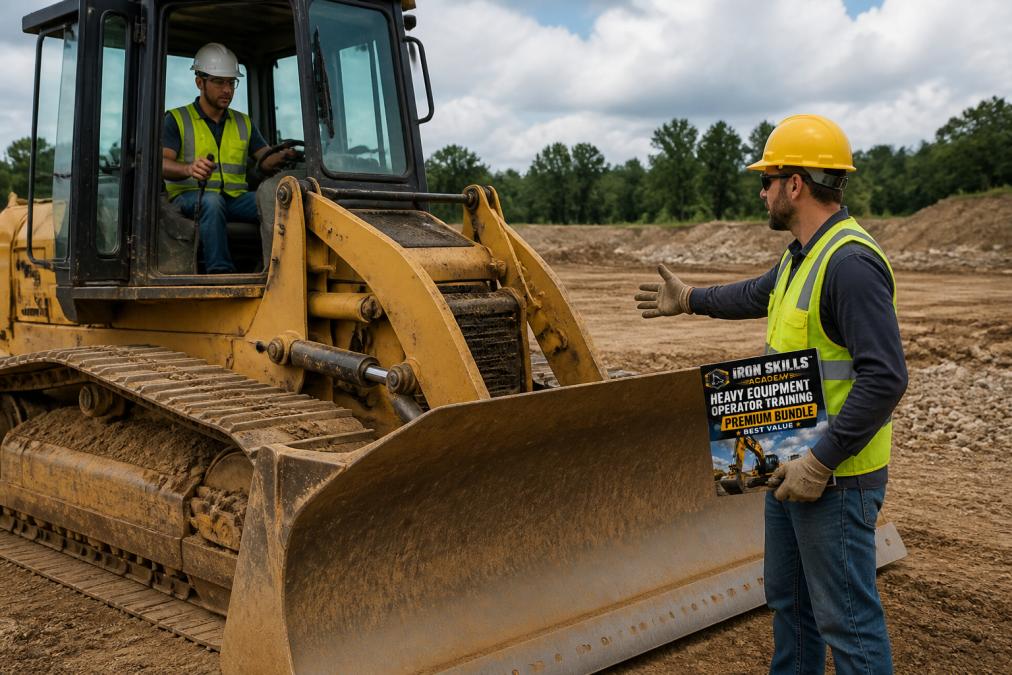
Practical machine time covers specific competencies that online modules cannot teach: blade control and precision, stability awareness on slopes, hazard identification in real-world site conditions, equipment response to different soil types, and emergency shutdown procedures. Instructors observe students operating equipment and provide real-time feedback on technique, safety compliance, and operational efficiency.
Virtual training and simulator-based preparation deliver equivalent learning outcomes at 10-15% of the cost of field training, making blended approaches cost-effective without sacrificing safety. Leading operators now allocate 40-60% of their operator training budgets to simulation platforms, recognizing that blended learning approaches produce operators with superior safety records and operational efficiency.
The practical assessment at the end of any legitimate program is non-negotiable. Candidates must demonstrate safe equipment operation, proper technique, hazard awareness, and site preparation competency. Online-only programs cannot conduct this assessment.
Best Practices for Heavy Equipment Operator Training
The highest-performing dozer training programs share specific structural characteristics that maximize learning outcomes and job readiness.

Integrated curriculum design aligns learning objectives to industry standards. Jose Miranda, a Special Industry Instructor at Tennessee College of Applied Technology (TCAT) Knoxville, explains: "The curriculum gives the students the reasons why they need to maneuver the machine a certain way even before they get on the simulator. It also gives them the information they will need when they are on the job site like safety, hazard awareness, and machine operation." Teaching the "why" before the "how" accelerates competency development.
Structured progression from theory to practice prevents common mistakes. Online modules cover equipment anatomy, control functions, safety protocols, and site preparation fundamentals. Simulator training bridges the gap by allowing students to practice blade positioning and basic operations in a controlled environment. Real equipment operation follows.
Safety-first instruction is mandatory. Every session must emphasize hazard recognition, proper positioning, equipment limitations, and emergency procedures. Construction companies using e-learning for OSHA training report 35% faster completion rates compared to in-person training when content is comprehensive and assessment-based.
Instructor expertise matters more than delivery format. A skilled instructor with real heavy equipment experience produces better outcomes than a mediocre instructor with students in the field. They should explain why a technique works and what happens when it doesn't.
Assessment at every stage ensures learners understand the material. Online modules should include quizzes and scenario-based questions. Lab sessions should include graded operations where instructors evaluate technique and safety compliance. Final certification requires practical demonstration of competency.
Customization for learner needs improves outcomes. Some operators benefit from additional simulator time before real equipment; others need extra safety protocol review. Programs allowing flexibility see higher completion rates and better on-the-job performance.
Iron Skills Academy's approach emphasizes this integration. The Heavy Equipment Operator Training Manual Premium Bundle provides comprehensive foundational knowledge across all major equipment types before students step into the equipment cab, accelerating hands-on learning and reducing classroom time.
Cost Comparison and ROI for Training Programs
Online-only programs typically cost $500-$1,200 per operator, reflecting content delivery and platform maintenance but not hands-on lab time. For employers using this as foundational training before on-the-job instruction, ROI is moderate; operators arrive with basic knowledge but require significant field mentoring.
In-person programs with full hands-on instruction range from $2,000-$4,000 per operator, reflecting equipment rental, fuel, insurance, and instructor time. Graduates emerge job-ready with certified competency, reducing employer onboarding time and safety risk.
Hybrid programs combining online learning with structured lab work typically cost $1,500-$2,500 per operator. ROI is highest because operators complete foundational learning faster, lab instructors focus on practical skills, and graduates are fully certified.
The real financial calculation extends beyond training cost:
Time to productivity: An operator completing a hybrid program arrives job-ready and generates revenue immediately. An operator requiring 4-6 weeks of additional field mentoring costs the employer in lost productivity and mentor time.
Safety compliance: Operators trained through structured programs with certified competency assessment have fewer accidents and safety violations, reducing insurance premiums and workers' compensation claims.
Retention: Operators receiving formal training through recognized programs show higher job satisfaction and retention rates. Replacing a trained operator costs 50-200% of their annual salary.
Employer-sponsored training ROI becomes significant at scale. A construction company training 10 operators annually through hybrid programs at $2,000 per operator invests $20,000. If this reduces onboarding time by 6 weeks per operator and prevents one safety incident annually (average cost $50,000+), the program pays for itself in the first year.
According to U.S. Department of Labor apprenticeship data, workers completing formal training programs earn 20% more over their careers than those trained informally, reflecting employer recognition of certified competency.
Iron Skills Academy's training materials support both employer-sponsored and individual learner pathways. The Heavy Equipment Operator Training Manual Student Edition provides comprehensive self-study content, making formal foundational training accessible regardless of program delivery method.
Which Training Format Should You Choose?
The answer depends on your specific constraints and goals.
Choose online-only training if:
- You need foundational knowledge quickly and cost is the primary constraint
- Your learners have existing field mentoring available
- You're preparing candidates for in-person lab sessions
- Budget limitations prevent comprehensive programs
The limitation is clear: online-only training produces knowledgeable candidates, not certified operators.
Choose in-person training if:
- Job readiness and immediate employability are priorities
- You need certified operators with minimal additional field mentoring
- Your learners can commit to fixed schedules
- Safety compliance is non-negotiable
In-person programs deliver the most comprehensive preparation, but higher cost and scheduling requirements make them impractical for some learners.
Choose hybrid training if:
- You want the balance of flexibility and job readiness
- You're training multiple operators and need efficient completion
- Your learners have some scheduling flexibility but can attend scheduled labs
- You want to minimize total training time without sacrificing competency
- Cost-effectiveness matters alongside quality outcomes
Hybrid programs represent the best balance for most operators and employers. They use online learning's flexibility and efficiency while maintaining the hands-on competency that employers demand.
Sally Porter, Strategic Impact Coordinator at Tennessee College of Applied Technology (TCAT) Knoxville, articulates the industry perspective: "We're answering a call directly from the industry. They don't have enough people. They want us to produce faster and train quicker. And then ultimately, they would like to see our program replicated across the state of Tennessee in all TCATs." This demand reflects that hybrid programs meet employer needs more effectively than either approach alone.
:::verdict Best choice for most operators: Hybrid training. It balances flexibility, cost, and job readiness. Online learning removes classroom inefficiencies while hands-on labs ensure certified competency. Choose in-person only if you have unlimited scheduling flexibility. Choose online-only only if cost is the absolute constraint and you have field mentoring available. :::
The heavy equipment operator shortage won't resolve itself. Training programs that understand the limitations of pure online delivery and the inefficiencies of traditional in-person instruction are producing operators faster and more cost-effectively. Operators emerging from structured hybrid programs with both foundational knowledge and certified hands-on competency are the ones employers hire first and retain longest.
The average yearly earnings of a heavy equipment operator is $46,080, significantly higher than the average salary for all occupations ($37,690). This financial incentive drives demand for quality training. Whether you're an individual seeking career advancement or an employer building workforce capacity, the training format you choose determines whether your investment produces operators who are merely trained or genuinely job-ready.
At Iron Skills Academy, we understand that operators need both knowledge and confidence. Our Heavy Equipment Operator Training Manual Premium Bundle equips students with comprehensive foundational content across dozers, excavators, wheel loaders, and other essential equipment before they step into the cab. Combined with structured hands-on lab work, this approach accelerates competency development and produces operators who excel on the job site. Start Training with Iron Skills Academy and build a team of operators who understand not just how to operate equipment, but why operational technique matters for safety and efficiency.
Frequently Asked Questions
What certification do you need to drive a bulldozer?
Heavy equipment operator certification requirements vary by jurisdiction and employer, but most require an operator license or certificate that demonstrates competency in dozer operation. Many states recognize OSHA-aligned credentials. Some employers require certification through vocational programs or community colleges. Certification typically includes classroom instruction on safety protocols, machine anatomy, and site hazards, plus a practical assessment where you operate the dozer under supervision. Iron Skills Academy's training manuals cover the foundational knowledge needed before pursuing formal certification.
Can you become a certified dozer operator through online training alone?
No. While online training covers essential classroom content like safety, equipment maintenance, and operational theory, full certification requires hands-on practical assessment with real equipment. A construction company cut training time by 50% using simulator-based learning, but still required field experience for job readiness. Reputable programs integrate both: online modules for foundational knowledge, then in-person lab time to operate the actual dozer. This blended approach ensures operators meet industry standards and employer expectations.
How long does it take to become proficient in dozer operation?
Dozer operator training course duration typically ranges from 4 to 12 weeks depending on the program format. Online components can be completed in 2-4 weeks of self-paced learning, while hands-on lab requirements usually add 40-80 hours of practical machine time. The U.S. Bureau of Labor reports strong demand for new operators, with employers prioritizing structured training that combines classroom instruction with field experience. Total proficiency depends on prior equipment experience and the intensity of the program.
How much does dozer training cost?
Training costs vary significantly. Virtual training delivers equivalent learning outcomes at 10-15% of the cost of field-only training, where a single hour of heavy equipment operation can cost $500-$2,000. Full certification programs range from $2,000 to $8,000 depending on duration and format. Iron Skills Academy offers comprehensive training manuals starting at affordable price points to build foundational knowledge before enrolling in hands-on programs. Employer-sponsored training often reduces out-of-pocket costs for employees.
What makes structured dozer training better than on-the-job training alone?
Structured training reduces time to competency and improves safety outcomes. A construction company improved instructor efficiency by 500% by combining simulator-based training with hands-on sessions. Structured programs teach site safety, hazard awareness, and proper machine operation techniques systematically, rather than relying on experienced operators to pass knowledge informally. This ensures all operators meet consistent industry standards and OSHA-aligned safety protocols. Instructors at vocational programs report that curriculum-based training produces faster, safer operators ready for the job site.
This article was written using GrandRanker