

Table of Contents
- Why Heavy Machinery Safety Training Fails Most Teams
- Heavy Equipment Safety Training Checklist for Teams
- OSHA Heavy Equipment Certification Requirements Explained
- How Long Does Heavy Equipment Certification Last?
- Heavy Equipment Accident Prevention Strategies That Work
- Top Heavy Machinery Safety Training Options for Teams in 2026
- How to Measure Training ROI and Verify Operator Skill
- Conclusion
Last Updated: August 17, 2026
Why Heavy Machinery Safety Training Fails Most Teams
Most heavy machinery safety training programs fail because training gets treated as a compliance checkbox rather than a genuine safety system. Teams confuse certification with competence: an operator can pass a written exam yet have dangerous blind spots when mounting equipment on uneven terrain or misjudging load capacity under time pressure.
Three failure patterns appear repeatedly: no site-specific context, no skill verification after training, and fatigue and mental load are ignored. Heavy machinery safety training is the structured process of teaching operators to identify hazards, follow safe operating procedures, and maintain regulatory compliance on industrial equipment including excavators, dozers, wheel loaders, skid steers, backhoes, and motor graders. Effective training combines technical knowledge, hands-on practice, and ongoing skill verification.
Heavy Equipment Safety Training Checklist for Teams
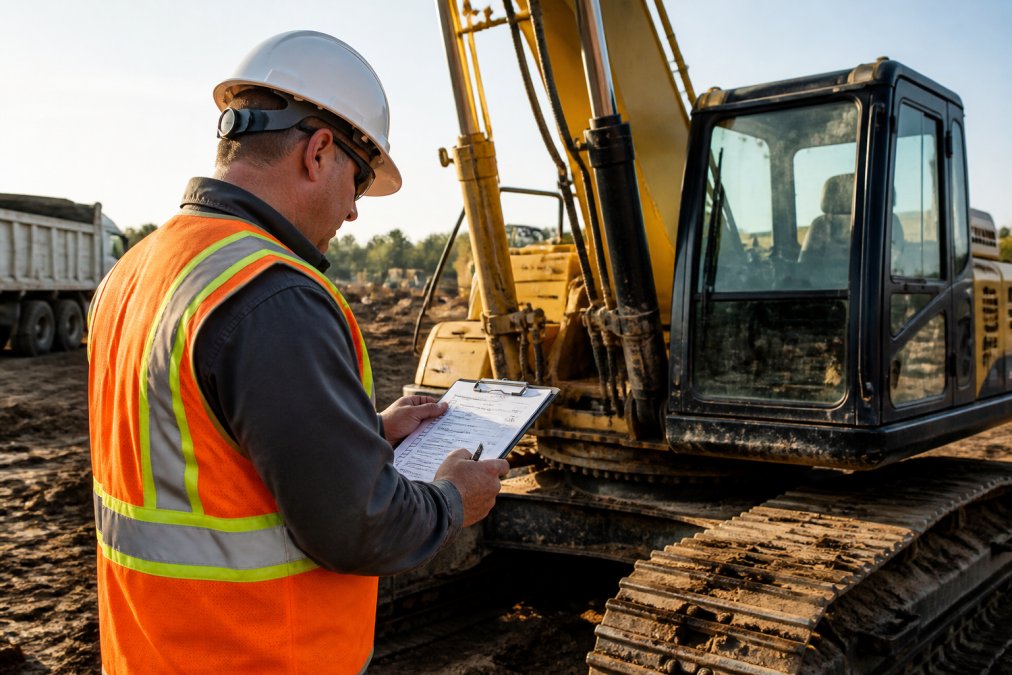
A structured checklist ensures operators cover every critical area before and during machine operation.
| Domain | Key Training Elements | Frequency |
|---|---|---|
| Pre-use inspection | Walk-around checks, fluid levels, structural integrity | Every shift |
| Mounting and dismounting | Three-point contact, cab entry sequence, dismount protocol | Every shift |
| Situational awareness | Blind spot mapping, spotter communication, pedestrian zones | Every shift |
| Work zone and excavation | Traffic control, trench safety, confined space protocols | Per task type |
Pre-Use Inspection Procedures
Pre-use inspection is the single most effective accident prevention tool available. Operators must conduct a structured walk-around before every shift, covering structural checks for cracks in the frame, bucket, blade, or boom; fluid levels including engine oil, hydraulic fluid, coolant, and fuel; tires and tracks for damage and correct pressure; safety systems including backup alarms, lights, mirrors, and rollover protection structures (ROPS); and controls checks at low throttle before beginning work.
The inspection log should be signed and dated, creating an accountability trail and supporting OSHA compliance documentation.
Safe Mounting, Dismounting, and Situational Awareness
The three-point contact rule is non-negotiable for mounting and dismounting: operators must maintain three points of contact with the machine at all times during entry and exit. Jumping from equipment is a leading cause of musculoskeletal injuries.
Situational awareness training must address blind spots directly. Every piece of heavy machinery has zones where the operator cannot see ground-level workers or obstacles. Training should include blind spot mapping where operators physically walk around their specific machine and mark visibility-limited areas, spotter protocols using standardized hand signals, and pedestrian exclusion zones establishing clear boundaries around operating equipment.
Work Zone Safety and Excavation Protocols
Work zone safety training should cover traffic control plan basics, flagging procedures, and equipment positioning relative to live traffic lanes. According to OSHA's excavation and trenching safety standards, trenches deeper than 1.5 metres require protective systems including sloping, shoring, or trench boxes. Operators working near excavations must understand soil classification, because unstable soil changes the risk profile of every machine movement near the trench edge. Confined space entry requires that the atmosphere be tested for oxygen levels, flammable gases, and toxic contaminants before any operator or worker enters.
OSHA Heavy Equipment Certification Requirements Explained
OSHA heavy equipment certification requirements are not a single universal credential; they are a framework of standards that define what operators must be trained to do and what employers must document. The OSHA general industry and construction standards require that operators of powered industrial equipment be trained and evaluated by a qualified person before independent operation.
Key OSHA compliance requirements include: operator qualification on specific equipment, written documentation of training records, refresher training triggers when operators are observed operating unsafely or after accidents, and competent person designation for excavation work. OSHA compliance is the floor, not the ceiling. Many teams meet minimum documentation requirements while operators still lack practical proficiency.
How Long Does Heavy Equipment Certification Last?
Most operator certifications require renewal every three to five years, though specific equipment categories and regulatory requirements vary. A practical approach is annual refresher training for all operators covering inspection procedures and regulatory updates, full recertification every three years for equipment-specific credentials, immediate retraining after any incident or observed unsafe behavior, and site-specific orientation whenever operators move to a new job site.
The continuous reinforcement of safe habits matters more than the renewal cycle. An operator who completed certification four years ago but practices correct procedures daily is safer than one who renewed last month but has developed shortcuts.
Heavy Equipment Accident Prevention Strategies That Work
Accident prevention requires addressing human factors, technology integration, and organizational culture simultaneously.
Wearable Safety Technology and Telematics
Telematics systems track machine hours, idle time, travel speed, and operator inputs, revealing patterns supervisors cannot observe directly. This data feeds into preventative maintenance schedules, reducing mechanical failure risk during operation.
Wearable technology includes fatigue monitoring wristbands that alert supervisors when operator alertness drops, proximity warning systems that trigger alerts when workers approach equipment exclusion zones, and smart hard hats with impact sensors. According to the National Safety Council's workplace safety technology research, technology-assisted safety programs consistently outperform compliance-only approaches in reducing incident rates.
Fatigue Management and Operator Mental Health
Fatigue is one of the most underaddressed risk factors in heavy equipment operation. Operating machinery requires sustained concentration over long shifts; fatigue degrades reaction time, decision-making, and situational awareness.
Effective fatigue management includes shift scheduling that avoids frequent day-night rotations, mandatory rest periods particularly for extended shifts or hot environments, and pre-shift fitness for duty checks where supervisors have authority to remove impaired operators. Operator mental health deserves equal attention. Teams that normalize conversations about mental load and provide support resources see lower turnover and fewer behavioral incidents.
Top Heavy Machinery Safety Training Options for Teams in 2026
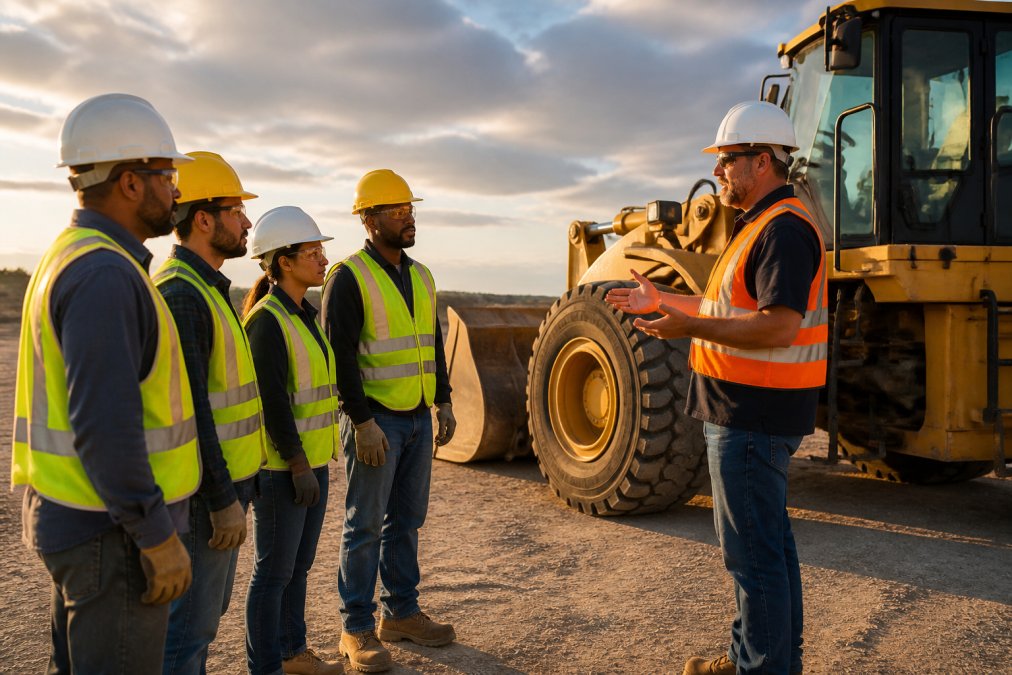
Choosing the right training program depends on your equipment mix, operators' experience levels, and whether you need hands-on certification, compliance documentation, or both.
Quick Picks:
- Best for equipment-specific curriculum: Iron Skills Academy, covers excavators, dozers, wheel loaders, skid steers, backhoes, and motor graders with dedicated operator and instructor resources
- Best for simulator-based training: Simlog or Quake Logic, PC-based and motion-based simulators for risk-free skill development
- Best for blended/onsite programs: TEEX or HEC, hands-on field training combined with classroom instruction
- Best for compliance tracking: Cat eLearning or Skillsoft, online platforms with course libraries and team management tools
1. Iron Skills Academy: Equipment-Specific Curriculum for Operators and Instructors
Iron Skills Academy provides structured, equipment-specific heavy machinery safety training covering excavators, dozers, wheel loaders, skid steers and compact track loaders, backhoe loaders, and motor graders. Each machine type gets dedicated training resources rather than a one-size-fits-all module, because inspection procedures, control inputs, and hazard profiles differ fundamentally between equipment types.
What separates Iron Skills Academy is the dual focus on operators and instructors. Vocational schools and in-house training programs get professional instructor packages. This means experienced operators transitioning into training roles get resources that genuinely extend their knowledge.
Best for: Safety officers at construction and mining companies, vocational instructors, business owners in agriculture and road maintenance needing to upskill teams on specific machine types.
2. Simulator-Based Training: Simlog and Quake Logic
Simulator-based training solves how to give operators hands-on practice without the cost and risk of putting inexperienced people on real machinery.
Simlog uses PC-based simulators with physical controls that work across multiple equipment types. The Simulation Manager software tracks session results, giving instructors objective performance data.
Quake Logic's QL 3-in-1 simulator adds a 3-degrees-of-freedom motion system and haptic feedback controls that replicate the physical sensation of operating equipment. Simulators excel at building foundational control skills and safety habits but must be paired with supervised real-equipment practice before independent operation.
3. Blended and Onsite Programs: TEEX and HEC
For teams needing hands-on certification with classroom reinforcement, blended programs from TEEX and Heavy Equipment Colleges of America (HEC) are the strongest options.
TEEX covers scrapers, bulldozers, motor graders, front-end loaders, excavators, dump trucks, and cranes. The blended approach combines hands-on field exercises with classroom instruction.
HEC focuses on onsite delivery: trainers come to your location, minimizing production disruption and ensuring training occurs on your actual equipment in your actual work environment.
4. Online and Compliance-Focused Platforms: Cat eLearning and Skillsoft
Cat eLearning offers over 40 courses covering safety, maintenance, pre-operation checks, and basic operating techniques. The interactive machine walkarounds cover hundreds of inspection points with structured guidance.
Skillsoft approaches training from a compliance management perspective. Their EHS course library updates as regulations change. The reporting dashboard makes compliance tracking straightforward for large teams.
| Training Option | Best For | Delivery Format | Certification Type |
|---|---|---|---|
| Iron Skills Academy | Equipment-specific operator and instructor training | Structured curriculum, remote-capable | Equipment-specific |
| Simlog | Cost-effective simulator training | PC-based simulator | Skill development |
| Quake Logic | Immersive simulator with performance analytics | Motion-based simulator | Skill verification |
| TEEX | Blended hands-on and classroom | Onsite + online | Completion certificates |
| HEC | Onsite team certification | Onsite | NCCCO crane certification |
| Cat eLearning | Foundational online knowledge | Online, LMS-compatible | Completion certificates |
| Skillsoft | Compliance management and EHS tracking | Online subscription | Compliance documentation |
How to Measure Training ROI and Verify Operator Skill
Training ROI in heavy equipment safety is measurable, but most teams don't measure it because they don't set up the right baselines before training begins.
Before training: Document incident and near-miss rates per machine type, equipment downtime hours attributed to operator error, and inspection compliance rates.
After training: Re-evaluate operators on specific competencies using standardized practical assessment, track incident and near-miss rates over 90 days post-training, and monitor inspection compliance rates and telematics data for behavioral changes.
Skill verification methods: Supervised practical evaluation on the specific machine the operator will use, scenario-based assessment where operators identify and respond to staged hazards, and telematics review comparing operator behavior data before and after training. According to the Centers for Disease Control and Prevention's NIOSH research on occupational safety training effectiveness, training programs that include practical skill verification consistently outperform knowledge-only assessments in reducing workplace incidents.
Have a qualified evaluator watch each operator perform a complete pre-use inspection and defined operating sequence. Score against a standardized rubric. Document results. Repeat the evaluation at 90 days.
Keeping a heavy equipment team safe, compliant, and operationally sharp requires more than a one-time certification event. Iron Skills Academy's equipment-specific curriculum covers excavators, dozers, wheel loaders, skid steers, backhoe loaders, and motor graders with dedicated resources for both operators and instructors, making it a practical foundation for teams that need structured heavy machinery safety training without a generic approach. Start Training with Iron Skills Academy and build a workforce that operates safely and confidently on every machine.
Frequently Asked Questions
What are the OSHA requirements for heavy equipment training?
OSHA does not issue a single universal certification for all heavy equipment operators, but it does mandate that employers ensure operators are competent through training, evaluation, and documentation. Specific standards apply by equipment type: cranes fall under 29 CFR 1926.1427, forklifts under 1910.178, and excavation work under 1926.651. For most construction equipment, employers must conduct site-specific training, document operator qualifications, and address identified hazards. Heavy machinery safety training programs should align with these regulatory standards to keep teams compliant.
How often should heavy machinery safety training be refreshed?
Refresh intervals depend on equipment type and applicable OSHA standards. Forklift operators must be re-evaluated every three years or after an observed unsafe act, near-miss, or equipment change. Crane operators require periodic recertification, typically every five years under NCCCO standards. For general heavy equipment, most safety officers schedule annual refresher training as a best practice, with additional sessions after incidents or when operators move to unfamiliar machinery. Site-specific hazards and regulatory updates should also trigger retraining.
Is online heavy machinery training sufficient for certification?
Online heavy machinery safety training covers foundational knowledge, hazard identification, OSHA compliance, and pre-use inspection procedures effectively. However, most certification standards also require demonstrated hands-on competency. Online courses work best as the knowledge component of a blended program, where classroom or digital learning is followed by supervised practical assessment on real equipment. For teams spread across multiple job sites, online training for the theory portion reduces downtime, while site-based skill verification confirms operators can perform safely in practice.
How can I improve safety culture among heavy equipment operators?
Building a genuine safety culture goes beyond compliance checklists. Start with structured heavy machinery safety training that includes post-training skill verification so operators know their competency is measured, not assumed. Incorporate fatigue management policies, since operator alertness directly affects accident rates. Use telematics data to identify risky operating patterns early. Recognize safe behavior publicly, and involve operators in hazard identification rather than issuing top-down mandates. Teams that participate in developing safety protocols show stronger adherence than those who simply receive them.
What should a heavy equipment safety orientation include?
A thorough heavy equipment safety orientation should cover the types of machinery on site and their load capacities, rollover protection systems, and PPE requirements. It should include a pre-use inspection walkthrough for each machine type, blind spot awareness and safe mounting and dismounting procedures, work zone traffic control rules, excavation and trenching safety, confined space entry protocols where applicable, and emergency response steps. Site-specific hazards must be addressed directly rather than relying on generic content, and every operator should sign off confirming they understood the material.
This article was written using GrandRanker