

Table of Contents
- How to Choose the Best Excavator Training as a New Operator
- Excavator Operator Certification Requirements Explained
- How Long Is Excavator Training? Program Lengths Compared
- Hands-On vs Online Excavator Training: Which Works Better?
- Top Excavator Training Programs for New Operators
- Salary, Career Outlook, and ROI of Getting Certified
- Which Excavator Training Program Should You Start With?
- Conclusion
Last Updated: August 17, 2026
Choosing the right excavator training program is one of the most consequential decisions a new operator will make. At Iron Skills Academy, we work with students, instructors, and safety officers across the heavy equipment industry. Below, we break down the best excavator training options for 2026, what certification requires, how long programs take, and which path gives you the fastest return on your investment.
Excavator training combines machine controls, OSHA-aligned safety protocols, pre-shift inspection procedures, and practical evaluation, all assessed against industry standards that employers actively check before hiring.
How to Choose the Best Excavator Training as a New Operator
The best excavator training for new operators matches your timeline, budget, and intended job site environment. A six-week full-immersion school suits someone leaving a previous career and needing job-ready credentials fast. A union apprenticeship suits someone willing to invest three or four years for long-term wage and benefit security. An online course suits someone who needs foundational safety knowledge before stepping onto a machine.
Here is what to evaluate before committing:
- Hands-on hours: How much time does the curriculum put you in the seat?
- Certification outcome: Does the program prepare you for NCCCO, NCCER, or employer-specific assessment?
- Instructor credentials: Are instructors certified craft professionals or former operators with field experience?
- Class size: Smaller cohorts mean more machine time per student.
- Job placement support: Does the school connect graduates with employers?
Machine Controls and Operation Basics
Operator competency begins with understanding the machine. A new operator needs to internalize the hydraulic systems that control the boom, arm, and bucket before worrying about grade targets or trench depth. Most programs teach machine controls in sequence: travel controls first, then swing radius and rotation, then boom and bucket articulation under load.
The key controls on a standard excavator include dual joysticks for boom, arm, bucket, and swing; foot pedals for travel and blade operation; and auxiliary circuits for attachments. Simulator-based programs are particularly effective at this stage, allowing new operators to build muscle memory without the risk of damaging equipment.
Safety Protocols, OSHA Standards, and Site Compliance
Site safety is the operating framework for every hour you spend on a machine. According to OSHA's excavation and trenching safety standards, trenching and excavation rank among the most hazardous construction operations, with cave-ins responsible for dozens of fatalities annually.
Quality excavator training programs cover:
- Pre-shift inspection procedures, including checking hydraulic lines, undercarriage, and cab controls
- Hazard recognition for underground utilities and unstable soil conditions
- Shoring and sloping requirements for trenching work
- Swing radius awareness and exclusion zones for ground personnel
- Job site compliance documentation and operator competency records
OSHA standards do not mandate a specific excavator operator license at the federal level, but they do require that operators be competent, which means trained, evaluated, and capable of identifying hazards. Many employers use this standard as the baseline for their own internal operator certification requirements.
Excavator Operator Certification Requirements Explained
Excavator operator certification is the formal process of demonstrating that an operator can safely and proficiently control the machine under real working conditions. The two most widely recognized frameworks in the United States are NCCCO (National Commission for the Certification of Crane Operators) and NCCER (National Center for Construction Education and Research). Both require a combination of written examination and practical evaluation conducted by an accredited assessor.
Written Examination and Practical Evaluation
The written examination for excavator certification typically covers machine components, hydraulic system fundamentals, load handling principles, excavation hazard recognition, and relevant safety regulations. The practical evaluation requires the candidate to demonstrate proficiency on an actual machine, including completing a pre-shift inspection, traveling the machine over a defined course, digging to a specified depth within tolerance, and loading a truck or stockpile with controlled swing radius.
Practical evaluation is the part most candidates underestimate. Classroom knowledge does not automatically translate to smooth machine operation. Programs that provide substantial in-the-seat hours before the practical test produce significantly better pass rates.
Employer-Sponsored Training and Union Apprenticeships
Many operators enter the industry through employer-sponsored training, where a contractor brings on a new hire and provides structured on-the-job learning alongside an experienced operator. Union apprenticeships through organizations like the International Union of Operating Engineers (IUOE) represent the most structured employer-linked path. The IUOE Local 150 Apprenticeship and Skill Improvement Program combines more than 6,000 hours of on-the-job learning with over 240 hours of classroom instruction at a dedicated training center.
How Long Is Excavator Training? Program Lengths Compared
Excavator training length depends entirely on the program format and the certification outcome you are targeting.
| Program Type | Duration | Hands-On Focus | Certification Outcome |
|---|---|---|---|
| Online safety course | 4-40 hours | None | Foundational knowledge only |
| Short intensive school | 5-6 weeks | High | Employer-ready, NCCCO-prep |
| Full-immersion school | 8 weeks / 400 hours | Very high | NCCER certifications |
| Union apprenticeship | 3-4 years | Extensive | Journeyman status |
| Employer-sponsored OJT | Ongoing | Moderate | Internal competency sign-off |
Plan for a minimum of four to six weeks of in-the-seat training before attempting a practical assessment.
Hands-On vs Online Excavator Training: Which Works Better?
Hands-on training produces job-ready operators. Online training produces informed ones. Both have a role in a complete excavator training curriculum, but they are not interchangeable.
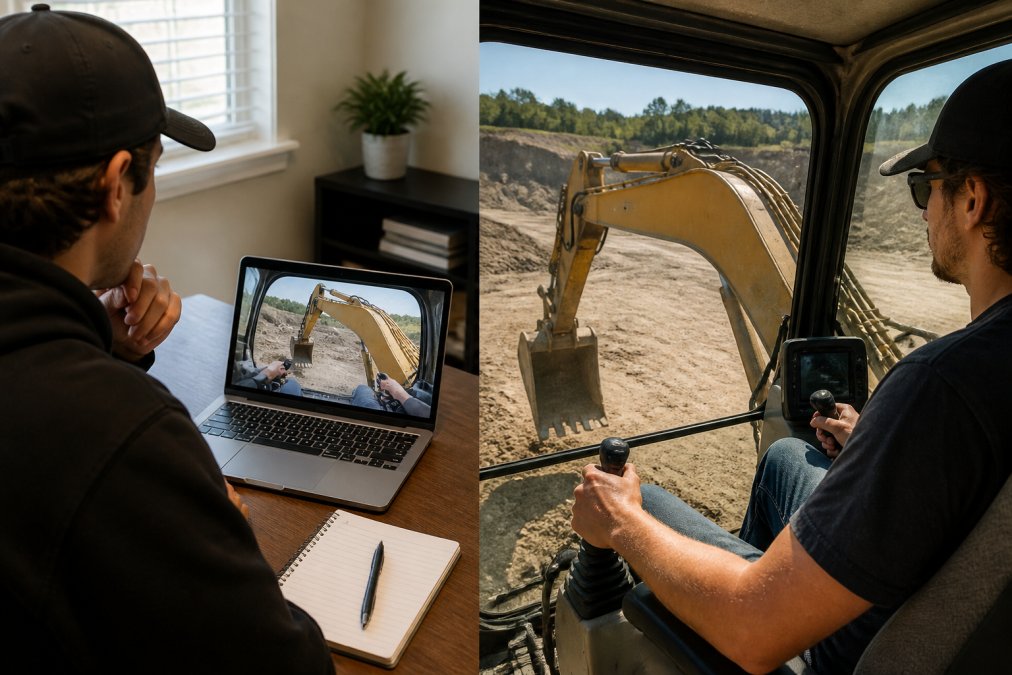
Online excavator training works well for building foundational knowledge before entering a school program, covering OSHA standards and safety protocols at your own pace, and refresher training for experienced operators returning after a break.
Hands-on training is non-negotiable for developing muscle memory on machine controls, passing a practical evaluation for certification, and learning to read ground conditions and load behavior in real time.
The most effective approach combines both: complete online coursework to absorb the theory, then enter a field program to apply it. Simulator-based training occupies a useful middle ground, offering physical controls and real-time performance feedback without the cost and risk of operating full-size equipment from day one.
Top Excavator Training Programs for New Operators
Quick Picks:
- Best Overall: Iron Skills Academy, comprehensive curriculum covering excavators, safety, and inspections for students and instructors
- Best Full-Immersion School: West Coast Training, 8-week, 400-hour program with NCCER certification
- Best for Long-Term Career: IUOE Apprenticeship, 6,000+ hours of on-the-job learning with union wages
- Best Simulator Option: VISTA Training or CM Labs, performance-tracked virtual training for safe skill development
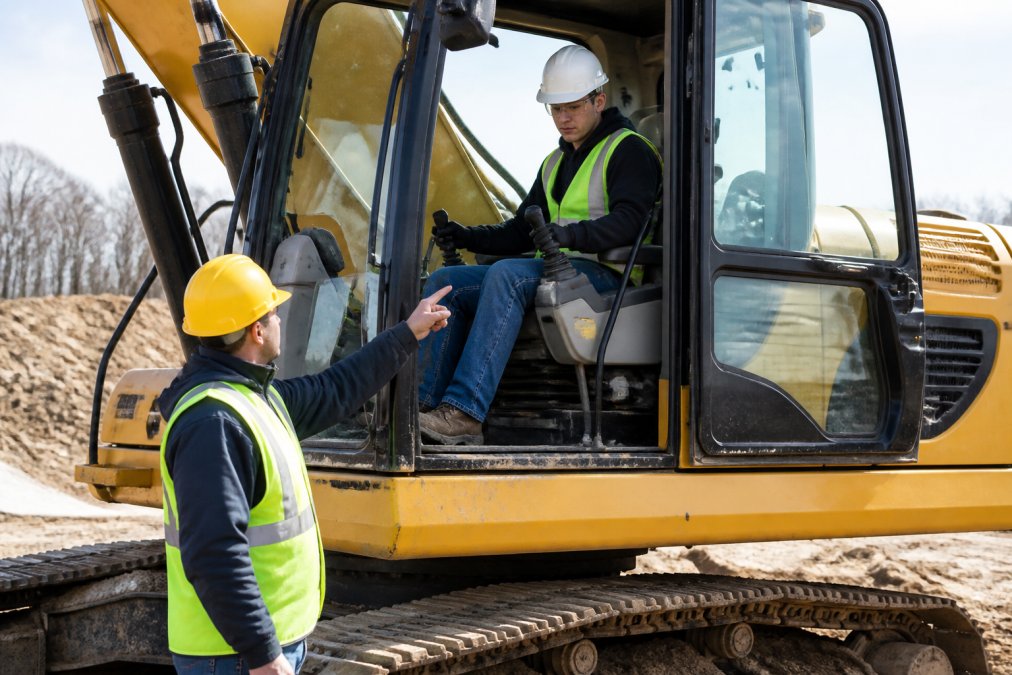
1. Iron Skills Academy, Best for Foundational and Instructor-Led Training
Iron Skills Academy is the top pick for new operators who need structured, curriculum-based training resources that cover excavators alongside the full range of heavy equipment. The curriculum addresses machine controls, safety protocols, pre-shift inspection procedures, and operational fundamentals, designed to serve both individual students and instructors delivering training at vocational schools or on-site.
What sets Iron Skills Academy apart is the depth of inspection knowledge embedded in the curriculum. Operators learn how to assess equipment before every shift, which is the competency that separates a compliant operator from a liability on a job site.
Best for: New operators building foundational knowledge, vocational instructors needing professional training packages, and safety officers ensuring workforce compliance.
Key strengths:
- Covers excavators, dozers, wheel loaders, skid steers, backhoes, and motor graders in a single curriculum
- Designed for both student and instructor use
- Emphasizes safety standards and equipment inspection knowledge
Visit Iron Skills Academy's website for current pricing and program options.
2. Full-Immersion School Programs: HCA and West Coast Training
Heavy Construction Academy (HCA) runs a six-week certification program covering multiple equipment types, including excavators, backhoes, bulldozers, and motor graders. The format combines classroom instruction with field demonstrations and in-the-seat operation.
West Coast Training takes a more intensive approach: an eight-week, 400-hour program with a maximum of 12 students per cohort. Small class sizes mean more machine time per student, and the curriculum is delivered by NCCER Certified Craft Instructors. Graduates can earn multiple NCCER certifications, which carry strong employer recognition across the construction industry.
Best for: Career changers who need job-ready credentials within six to eight weeks and can commit to full-time attendance.
3. Simulator-Based Training: VISTA and CM Labs
Simulator training has matured significantly. VISTA Training's hydraulic excavator simulator uses a building-block approach, progressing from basic tasks like trench crossing to complex operations like truck spotting and bench climbing. The software captures performance data on speed, care, productivity, and cycle time, giving instructors and trainees specific, actionable feedback.
CM Labs focuses specifically on mini excavator simulation, offering a training pack that runs from beginner-friendly exercises to advanced skill challenges. The realistic machine behavior helps operators build intuition that transfers to real equipment.
Best for: Training centers, companies looking to reduce equipment wear during initial training, and new operators who want structured practice before their first in-the-seat evaluation.
4. Union Apprenticeships: IUOE
The IUOE apprenticeship path is the longest route and the most financially rewarding over a career. The Local 150 Apprenticeship and Skill Improvement Program operates from a 300-acre training center in Wilmington, Illinois, with over 200 pieces of heavy equipment and a dedicated simulator lab. Apprentices receive more than 6,000 hours of on-the-job learning combined with 240-plus hours of classroom instruction.
The trade-off is time. This is a three-to-four-year commitment, and the program is geographically specific to the Local 150 service area covering Illinois, Indiana, and Iowa. Other IUOE locals operate similar programs across the country; check IUOE's national training program directory for the local nearest you.
Union membership typically provides wage scales, health benefits, and pension contributions that significantly change the long-term ROI calculation.
Best for: Operators committed to a long-term career in heavy construction who want structured advancement, union wages, and comprehensive field experience.
Salary, Career Outlook, and ROI of Getting Certified
Certified excavator operators earn more than uncertified ones. The gap widens further with union membership and specialization in technical work like trenching for utilities, shoring for deep excavations, or GPS-guided grading.
According to Bureau of Labor Statistics Occupational Outlook Handbook for construction equipment operators, construction equipment operators earn a median annual wage that places them solidly in the skilled trades tier, with the top quartile earning substantially more in high-demand markets and union environments. The BLS also projects continued demand for operators as infrastructure investment and residential construction activity sustain hiring.
The ROI calculation for excavator training depends on the program cost relative to the wage premium it unlocks. A six-week full-immersion program that costs several thousand dollars pays back within the first year if it moves you from unskilled labor wages to a certified operator rate.
| Career Path | Time to Employment | Certification Level | Long-Term Earning Potential |
|---|---|---|---|
| Online course only | Immediate (limited roles) | Foundational knowledge | Low without practical follow-up |
| 6-8 week school | 2-3 months | Employer-ready, NCCER | Moderate to high |
| Union apprenticeship | 3-4 years | Journeyman | High, with benefits |
| Employer-sponsored OJT | Immediate | Internal competency | Variable |
Which Excavator Training Program Should You Start With?
The right starting point depends on where you are right now.
If you have zero experience and need to understand the basics before committing to a program: Start with an online course covering OSHA standards, machine controls, and pre-shift inspection procedures. This gives you the vocabulary and safety awareness to get more out of hands-on training.
If you are ready to commit full-time and want job-ready credentials within two months: Choose a full-immersion school like HCA or West Coast Training. The structured curriculum, in-the-seat hours, and NCCER certification pathway give you the strongest foundation for immediate employment.
If you are an instructor or safety officer building a training program for your team: Iron Skills Academy's curriculum packages are designed specifically for this use case, covering excavators and the full range of heavy equipment with materials suitable for both classroom delivery and individual study.
If you are playing a long game: Apply to your regional IUOE local. The apprenticeship path is slower, but the combination of structured technical training, field experience, and union representation produces the most complete operators in the industry.
The operators who advance fastest typically combine approaches: foundational online training, a structured school program for hands-on proficiency, and ongoing skill development through employer-sponsored assessment or union upgrade training.
Choosing the right excavator training comes down to matching the program format to your timeline and career goals. Operators who enter with structured foundational knowledge progress faster and make fewer costly mistakes. Iron Skills Academy provides the curriculum framework that supports both individual learners and the instructors guiding them, covering machine controls, safety protocols, and inspection procedures across excavators and the full range of heavy equipment. Start Training with Iron Skills Academy and build the operational foundation that employers and certifying bodies actually look for.
Frequently Asked Questions
How long does it take to learn how to use an excavator?
Basic machine controls and safe digging fundamentals can be grasped in a few days of hands-on practice. A structured excavator training program typically runs anywhere from one week to eight weeks depending on the format. Short intensive courses focus on operator competency for a single machine type, while full heavy equipment programs covering multiple machines and OSHA standards can take six to eight weeks. Reaching genuine field proficiency usually requires additional months of supervised on-the-job experience after formal training ends.
What certifications do I need to operate an excavator?
No single federal license is required to operate an excavator in most jurisdictions, but excavator operator certification through bodies such as NCCCO or NCCER is widely recognised by employers and demonstrates operator competency. Many job sites also require proof of OSHA-aligned safety training covering excavation hazards, trenching, shoring, and underground utilities. Some states and municipalities impose additional requirements, so checking local regulations before starting a program is advisable. Employer-specific skill assessments are common on top of any formal certification.
Is online excavator training as effective as hands-on training?
Online excavator training builds essential foundational knowledge: machine controls, pre-shift inspection procedures, hydraulic systems, load handling, swing radius awareness, and OSHA standards. However, it cannot replace hands-on practice on real equipment. Employers consistently require a practical evaluation before allowing new operators on site. The most effective approach combines online or classroom instruction for theory with in-the-seat field experience. Simulator-based training bridges the gap, offering a safe environment to build proficiency before touching real heavy machinery.
How much does an excavator operator course cost?
Course costs vary significantly by format and duration. Short online safety courses are the least expensive entry point. Intensive multi-week residential programs at vocational schools range from a few thousand dollars to over ten thousand dollars, depending on program length, equipment access, and certification included. Union apprenticeships through organisations like IUOE typically involve dues rather than upfront tuition. For Iron Skills Academy's current pricing and available packages, visit the Iron Skills Academy website directly for an accurate quote.
How do I find accredited excavator training near me?
Start by searching for programs that hold NCCER or NCCCO accreditation, as these credentials are recognised by construction and mining employers across the country. Local community colleges, vocational schools, and union training centres often run hands-on programs. If travel is a barrier, online foundational courses from providers like Iron Skills Academy let you complete technical training and inspection knowledge remotely before arranging local in-the-seat hours. Always confirm that any program includes a practical evaluation component, not just a written examination.
This article was written using GrandRanker