

Table of Contents
- Why Motor Grader Training for Instructors Matters Now
- Building a Motor Grader Operator Training Curriculum
- Motor Grader Training Duration and Pacing
- Essential Heavy Equipment Training Instructor Tools
- Safety Protocols and Hazard Awareness for Instructors
- Best Practices for Teaching Heavy Machinery Operation
- Certification and Compliance Standards
- Building Your Instructor Program: Tools and Resources
- Frequently Asked Questions
Last Updated: September 2, 2026
Why Motor Grader Training for Instructors Matters Now
The construction industry faces a critical operator shortage. According to U.S. Bureau of Labor Statistics occupational data, approximately 42,500 openings for construction equipment operators are projected each year through 2035, with overall employment expected to grow 4 percent. The real bottleneck isn't just finding operators, it's finding qualified instructors who can teach them.
Motor grader training for instructors has become essential infrastructure. The global operator training simulator market was valued at USD 12.6 billion in 2025 and is projected to grow to USD 30.5 billion by 2033, at a CAGR of 11.9% (Grand View Research, 2026) (grandviewresearch.com). This growth reflects a fundamental shift: construction companies can no longer rely on informal apprenticeships. They need structured, repeatable training delivered by instructors who understand both the machine and how to teach it.
At Iron Skills Academy, we provide comprehensive heavy equipment training resources designed to enhance safety and operational proficiency. An instructor who can break down motor grader operation into teachable modules, assess competency accurately, and prioritize safety creates operators who stay longer, make fewer costly mistakes, and advance faster into specialized roles.

This guide covers everything you need to deliver professional motor grader training for instructors: curriculum design, hands-on evaluation methods, compliance standards, and the practical tools that separate mediocre training from training that actually sticks.
Building a Motor Grader Operator Training Curriculum
A structured curriculum is the foundation of effective motor grader training for instructors. Without one, you're teaching from experience alone, which doesn't scale or transfer to the next instructor.
The construction industry's 650,000 worker shortage (LinkedIn, 2025) creates enormous demand for qualified instructors, but demand without structure produces inconsistent results (linkedin.com). Your curriculum needs to answer three questions: What must every operator know? How do we verify they know it? What happens if they don't?
Core Modules Every Curriculum Needs
A complete motor grader operator training curriculum should include five core modules, each building on the previous one.
Machine Anatomy and Controls forms the foundation. Operators need to understand what each control does and why it matters. Cover the moldboard, blade angle, articulation, circle drive, and hydraulic systems. Explain the physics: why blade angle affects finish quality, how articulation changes the machine's footprint, and what happens when you combine multiple adjustments simultaneously.
Pre-shift Inspection and Maintenance comes next. An operator who skips pre-shift inspection is a liability. Cover fluid levels, tire condition, hydraulic hose integrity, control responsiveness, and warning light diagnostics. Teach operators to recognize early signs of wear before they become catastrophic failures.
Operating Fundamentals and Techniques is where operators learn to actually use the machine. Cover basic maneuvers: straight grading, angling the blade, cutting to grade, and working with 3D machine control systems. This module requires hands-on practice.
Safety Protocols and Hazard Recognition must be woven through every module, but it deserves dedicated focus. Cover worksite hazards specific to motor grader operation: visibility limitations, rollover risks, pedestrian interaction, and equipment interaction with other machinery.
Professional Judgment and Problem-Solving is the capstone module. Real-world grading rarely follows textbook conditions. Teach operators how to diagnose problems, adjust technique on the fly, and make decisions when conditions change.
Structuring Classroom and Field Components
The balance between classroom and field training determines whether your program produces competent operators or graduates who need months of on-the-job remediation.
Classroom instruction should cover theory, safety protocols, and control familiarity. Use video demonstrations, interactive simulations, and discussion of common mistakes. Keep sessions to 2-3 hours maximum, as attention drops sharply after that.
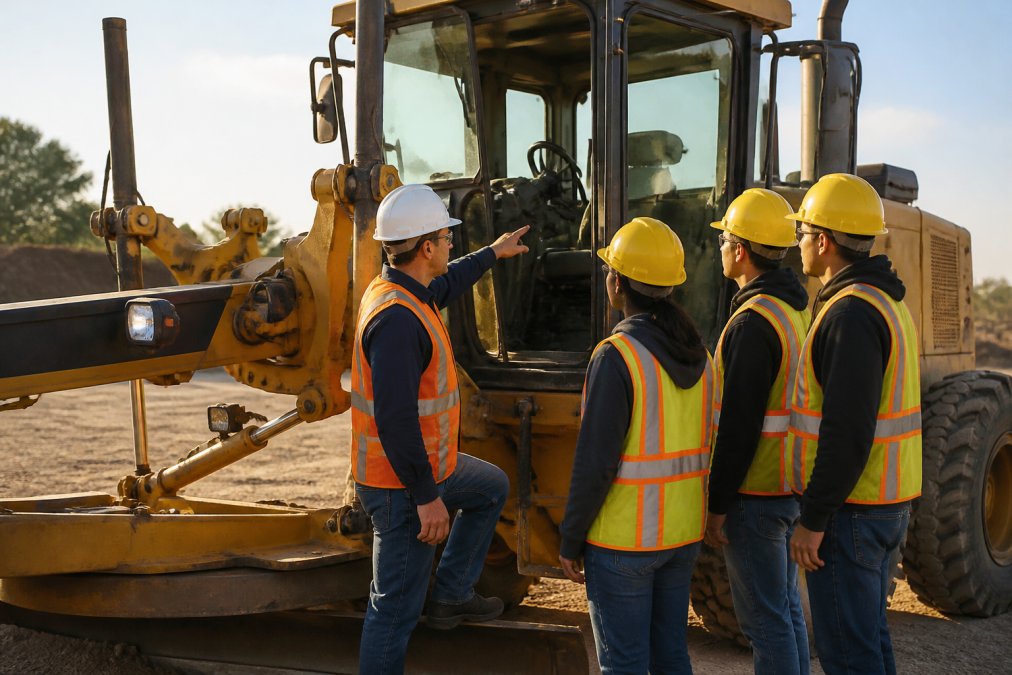
Field training is where competency develops. A motor grader instructor working with a 1:1:3 ratio (one instructor, one machine, three participants) can deliver meaningful feedback. Participants get hands-on time while observing peers, which accelerates learning through observation.
The most effective programs alternate between classroom and field: introduce a concept in the classroom, practice it in the field, debrief results back in the classroom. This cycle reinforces learning and gives operators time to process their experience.
Motor Grader Training Duration and Pacing
How long should motor grader training for instructors take? The answer depends on the operator's starting point and your program's depth, but industry standards provide clear guidance.
A foundational program covering basic operation, pre-shift inspection, and essential safety typically requires 40-60 hours of instruction: 16-24 hours of classroom work and 24-36 hours of field training, spread over 1-2 weeks.
Programs targeting advanced competency (including 3D machine control, complex grading scenarios, and troubleshooting) run 80-120 hours over 2-4 weeks.
Pacing matters as much as duration. Compressed programs (40 hours in one week) create cognitive overload. Stretched programs (40 hours over 8 weeks) lose momentum. The sweet spot is 20-30 hours per week over 2-3 weeks for foundational training. Operators need rest days, back-to-back field training produces fatigue-related mistakes and reduces retention. A weekly schedule of Monday-Wednesday field training with Thursday classroom review and Friday assessment works better than daily sessions.
Essential Heavy Equipment Training Instructor Tools
The right tools transform instruction from demonstration-based teaching to data-driven feedback. Modern instructors need four categories of tools.
Simulation Software accelerates learning and reduces equipment wear. Operators practice basic maneuvers, emergency procedures, and complex scenarios without running the actual machine. Simulators cost $50,000-$150,000 but pay for themselves through reduced fuel, maintenance, and damage.
Performance Monitoring Systems capture real-time data during field training. GPS-based systems track blade position, grade accuracy, and machine movements. Instructors can review recordings with operators, providing objective feedback far more effective than subjective commentary.
Assessment Tools and Checklists ensure consistent evaluation. A standardized checklist for pre-shift inspection, control operation, and safety compliance removes ambiguity and allows comparison across cohorts.
Documentation and Certification Platforms track progress and generate compliance records. When an operator completes a module, the system records it with timestamps and assessment scores, creating an audit trail.
Iron Skills Academy's Instructor Training Package provides comprehensive curriculum materials, assessment frameworks, and field training guides specifically designed for instructors delivering motor grader training. The package includes pre-built modules, safety protocols, and evaluation rubrics, giving you a proven foundation rather than starting from scratch. You can learn more and start training with the Iron Skills Academy™, Instructor Training Package [https://ironskills.myshopify.com/products/untitled-aug13_09-47-10].
Safety Protocols and Hazard Awareness for Instructors
Safety isn't a module you teach once. It's the operating system that runs underneath everything else. As an instructor, your job is to embed safety thinking into every decision an operator makes.
Pre-shift Inspection as a Teaching Foundation
The pre-shift inspection is your most powerful teaching tool. It's not just a checklist, it's a diagnostic process that trains operators to think systematically about the machine.
Walk operators through the inspection in sequence: external walk-around (tire condition, hydraulic hose integrity, visible damage), operator cabin (fluid levels, control responsiveness, warning lights), and functional test (steering, blade movement, hydraulic pressure).
The goal is to develop a habit. An operator who performs pre-shift inspection consistently catches problems before they become failures. Make the inspection interactive by asking operators: "What would happen if this hydraulic hose failed during operation?" This transforms inspection from rote procedure into active problem-solving.
Worksite Safety and Equipment-Specific Hazards
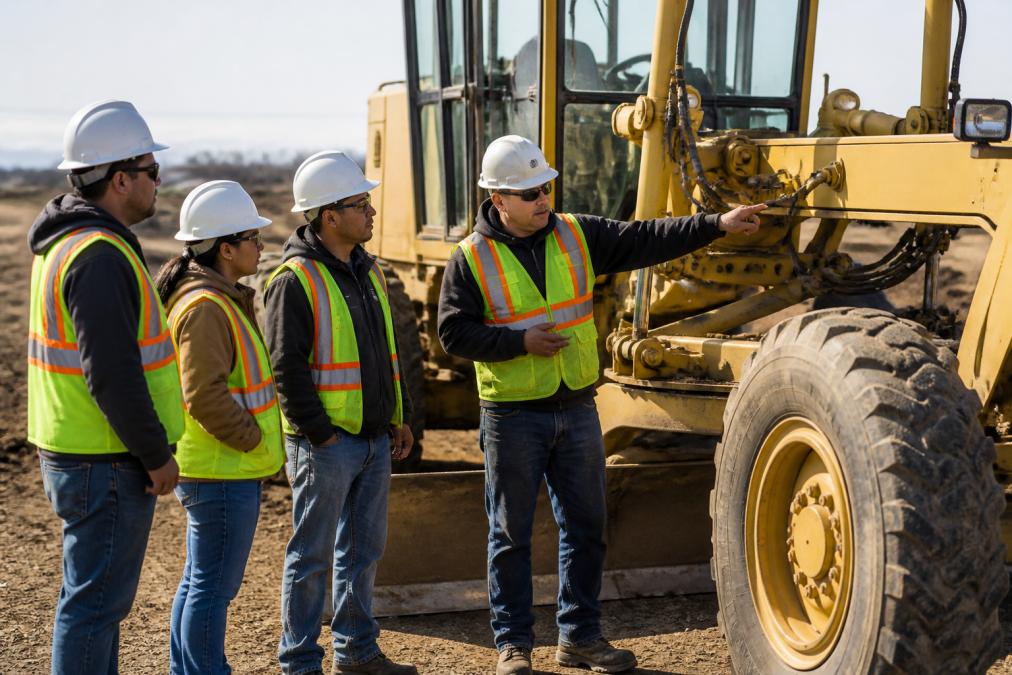
Motor graders create specific hazards that operators must recognize and mitigate. Visibility is the primary concern, the operator cabin sits high, but sight lines are limited, especially on the left side. Teach operators to use spotters on unfamiliar sites and to move slowly when visibility is compromised.
Rollover risk increases on slopes. A motor grader on a steep slope with improper blade angle or articulation can tip. Teach operators to assess slope angle before beginning work and to adjust technique accordingly.
Pedestrian interaction creates another hazard class. Operators must maintain awareness of workers near the machine, especially those outside the operator's direct line of sight. Establish clear communication protocols on your jobsites: hand signals, radio check-ins, or dedicated spotters.
Best Practices for Teaching Heavy Machinery Operation
Teaching motor grader operation is fundamentally different from teaching theory. Operators learn by doing, but they learn faster when guided by someone who understands both the machine and how people learn.
Hands-on Practical Evaluation Methods
Evaluation in field training must be objective and repeatable. Use a rubric that scores specific competencies: control smoothness, grade accuracy, safety awareness, and decision-making. Define observable behaviors rather than vague descriptors.
Video review is invaluable. Record field training sessions and review them together. Operators see their own mistakes more clearly when watching themselves than when hearing about them verbally. Peer evaluation adds another dimension, have operators watch each other work and provide feedback, which develops critical thinking and exposes operators to different problem-solving approaches.
Machine Controls and Operating Fundamentals
Teaching machine controls requires understanding that operators are learning cause-and-effect relationships. When you move the articulation control, the machine's rear wheels angle, changing the footprint and the blade's path.
Start with single-control movements. Operator moves articulation control only and observes what happens. Then add a second control: articulation plus blade angle. Build complexity gradually. This scaffolding prevents cognitive overload and creates a mental model the operator can build on.
Use exaggerated movements initially to see the full range of motion, then work toward precision. This develops both understanding and muscle memory.
Machine control technology has simplified operation for new operators, but it's also created a teaching challenge: operators who can achieve good results without understanding why. Your job is to ensure they understand the underlying principles so they can troubleshoot when technology fails or conditions require manual adjustment.
Certification and Compliance Standards
Certification gives operators and employers confidence that training met a standard. It also creates accountability for your program.
OSHA doesn't mandate specific heavy equipment operator certifications, but many states, counties, and private companies require them for public works projects. Common certifications include NCCER (National Center for Construction Education and Research) credentials, state-specific operator licenses, and company-specific certifications.
Your motor grader training for instructors should align with relevant standards in your market. Build your program to meet or exceed those standards and maintain records of all training completed, assessments passed, and certifications awarded. This creates a defensible record if an accident occurs and training quality is questioned.
Building Your Instructor Program: Tools and Resources
Launching a motor grader instructor program requires infrastructure beyond curriculum. You need assessment tools, documentation systems, and ongoing professional development for instructors.
Start with Iron Skills Academy's Instructor Training Package, which provides ready-built curriculum modules, assessment rubrics, and field training guides. This foundation saves months of development time and ensures your program covers essential competencies from day one. The package includes materials for excavators, dozers, wheel loaders, skid steers, backhoes, and motor graders, so you can expand your program as demand grows. You can learn more and start training with the Iron Skills Academy™, Instructor Training Package [https://ironskills.myshopify.com/products/untitled-aug13_09-47-10].
Build a simple tracking system that records which operators completed which modules, assessment scores, and certification status. This helps you identify knowledge gaps in your program and creates compliance documentation.
Create a feedback loop. After operators complete training and work in the field for 30-60 days, ask their supervisors whether they're productive, safe, and making mistakes that suggest training gaps. Use that feedback to refine your curriculum.
Invest in instructor development. Your instructors need ongoing training on new machine technology, updated safety standards, and teaching methodology. Annual professional development keeps your program sharp.
Motor grader training for instructors is no longer optional for construction companies serious about safety and productivity. The operator shortage means you can't rely on external hiring, you have to develop talent internally. That requires instructors who understand both the machine and how to teach it.
Iron Skills Academy's Instructor Training Package gives you a structured foundation: comprehensive curriculum, assessment frameworks, and field training protocols proven across heavy equipment types. Get started with Iron Skills Academy and build the instructor program that transforms your operator training from informal apprenticeship to professional development. You can learn more and start training with the Iron Skills Academy™, Instructor Training Package [https://ironskills.myshopify.com/products/untitled-aug13_09-47-10].
=== FAQ ANSWERS (audit these too, same rules) ===
[1] Q: What are the core competencies required for a motor grader instructor? A: Motor grader instructors must combine technical expertise with teaching ability. Core competencies include deep knowledge of machine controls, pre-shift inspection procedures, and operating fundamentals. Instructors must also understand worksite safety protocols, hazard identification, and regulatory compliance standards. Beyond technical skills, effective instructors develop curriculum, assess student competency, and communicate complex procedures clearly.
[2] Q: How long does motor grader training duration typically take for a complete program? A: Complete motor grader training programs range from one to two days for intensive workshops to multi-week programs for comprehensive certification. A standard operator training course includes hands-on instruction plus classroom modules covering safety, inspections, and operating procedures. The total duration depends on student experience level, training intensity, and whether the program includes field training. Instructors should plan for 20-40 hours of total contact time for operators new to motor graders, with optional one-on-one field training extending the timeline for deeper skill development.
[3] Q: How do you structure a motor grader training curriculum effectively? A: An effective motor grader operator training curriculum balances classroom instruction with hands-on field training. Start with safety protocols and worksite hazards, then move to pre-shift inspection requirements and machine anatomy. Progress to operating fundamentals, including controls, blade pitch, articulation, and crown adjustments. Integrate maintenance and troubleshooting content, then advance to practical evaluation methods where students demonstrate competency. Incorporate both classroom modules and field training so students experience real-world conditions and challenges.
[4] Q: What heavy equipment training instructor tools should I use to deliver effective training? A: Essential instructor tools include structured training manuals, curriculum guides, and pre-operation inspection checklists tailored to motor graders. The Iron Skills Academy Instructor Training Package provides comprehensive materials covering operator safety, inspections, operating fundamentals, and equipment-specific training. Digital resources, online modules, video demonstrations, and assessment templates, help instructors standardize content across multiple sessions. Practical tools include evaluation rubrics for hands-on skills, maintenance logs for equipment tracking, and safety documentation templates. Combining structured materials with hands-on resources ensures consistent, professional instruction regardless of instructor experience level.
Frequently Asked Questions
Q: What are the core competencies required for a motor grader instructor?
A: Motor grader instructors must combine technical expertise with teaching ability. Core competencies include deep knowledge of machine controls, pre-shift inspection procedures, and operating fundamentals. Instructors must also understand worksite safety protocols, hazard identification, and regulatory compliance standards. Beyond technical skills, effective instructors develop curriculum, assess student competency, and communicate complex procedures clearly.
Q: How long does motor grader training duration typically take for a complete program?
A: Complete motor grader training programs range from one to two days for intensive workshops to multi-week programs for comprehensive certification. A standard operator training course includes hands-on instruction plus classroom modules covering safety, inspections, and operating procedures. The total duration depends on student experience level, training intensity, and whether the program includes field training. Instructors should plan for 20-40 hours of total contact time for operators new to motor graders, with optional one-on-one field training extending the timeline for deeper skill development.
Q: How do you structure a motor grader training curriculum effectively?
A: An effective motor grader operator training curriculum balances classroom instruction with hands-on field training. Start with safety protocols and worksite hazards, then move to pre-shift inspection requirements and machine anatomy. Progress to operating fundamentals, including controls, blade pitch, articulation, and crown adjustments. Integrate maintenance and troubleshooting content, then advance to practical evaluation methods where students demonstrate competency. Incorporate both classroom modules and field training so students experience real-world conditions and challenges.
Q: What heavy equipment training instructor tools should I use to deliver effective training?
A: Essential instructor tools include structured training manuals, curriculum guides, and pre-operation inspection checklists tailored to motor graders. The Iron Skills Academy Instructor Training Package provides comprehensive materials covering operator safety, inspections, operating fundamentals, and equipment-specific training. Digital resources, online modules, video demonstrations, and assessment templates, help instructors standardize content across multiple sessions. Practical tools include evaluation rubrics for hands-on skills, maintenance logs for equipment tracking, and safety documentation templates. Combining structured materials with hands-on resources ensures consistent, professional instruction regardless of instructor experience level.
This article was written using GrandRanker